
 English
 Deutsch
 Español
 Français

Here You Can Get Our Latest Information
Industry News
How Hot Does a Solar Shower Get? Real Temperature Ranges by Capacity and Sunlight
How Hot a Solar Shower Gets: The Direct Answer
In full summer sun, an outdoor solar shower typically heats its water to between 38°C and 55°C (100°F to 131°F). The exact figure is decided by tank volume, the starting water temperature, air temperature, wind, and how long the unit sits in unobstructed light. A small 8L column can pass 55°C on a hot afternoon. A 60L column standing in the same garden usually stops closer to 45°C, because the same collector surface is warming three times more water.
Peak temperature normally arrives between 11:00 and 15:00, roughly two to four hours after filling and positioning. Water stays comfortably usable for another two to four hours after peak, then falls away quickly once a wall, a tree or a roofline cuts the sunlight. If you need one planning number, use 45°C: that is a realistic, repeatable target for an 18L or 30L column on a clear day in a temperate summer. Everything above 45°C is a weather bonus, not a product guarantee.
These numbers come from repeated bench tests on our own production line, not from a single afternoon in somebody's backyard. The rest of this page breaks the range down by capacity, explains which variables push the reading up or down, and shows where the safe operating window sits.
Peak Water Temperature by Tank Capacity
Capacity is the single factor most buyers underestimate. Two showers with identical absorber material and identical sun exposure will not finish the day at the same temperature if one holds 18 litres and the other holds 35. The larger body has more thermal mass, so it climbs slower, plateaus lower and holds usable warmth longer into the evening. The table below reflects our standard test conditions: fill at 09:00 with 20°C mains water, place the unit in unshaded sun, and record the reading at 15:00 with 28-32°C air temperature.
| Capacity | Typical peak at 15:00 | Time to pass 40°C | Where it fits best |
|---|---|---|---|
| 8L | 50-58°C | 1.5-2 hours | Beach rinse, poolside foot wash, one quick user |
| 18L | 45-55°C | 2.5-3 hours | Garden or pool edge, two consecutive showers |
| 20L soft bag | 42-52°C | 3-3.5 hours | Camping, hiking, transport in a vehicle |
| 30L | 42-50°C | 3-4 hours | Family poolside use, longer rinse cycles |
| 35L | 40-48°C | 3.5-4.5 hours | High-volume garden use, three or more users |
| 60L | 38-46°C | 4.5-6 hours | Group facilities, guest houses, pool clubs |
Read the table as a band, not a fixed score. The 8L cell at the top is narrow and shallow, so the sun reaches every litre and the whole body heats almost evenly. That is why a small column overtakes a large one by early afternoon. The 60L cell carries far more water than its absorber area can lift in six hours of daylight, so a portion of that volume stays lukewarm and mixes down the outlet temperature.
There is a practical lesson hidden in this: bigger is better for shower duration, smaller is better for shower temperature. If a family of four wants hot water at 17:00, a 35L column heated since morning will deliver more total hot litres than an 18L unit, even though its thermometer reads lower. If a couple wants the hottest possible water at 13:00, the 18L wins every time.
Heating Curve: What Happens Hour by Hour
The temperature does not rise in a straight line. Most solar shower bodies gain heat fastest in the first 90 minutes, then the curve flattens as the difference between water temperature and air temperature grows and heat loss through the walls starts to match heat gain from the sun. The two curves below show an 18L and a 35L column filled at the same moment and left in the same garden.
| Clock time | 18L column | 35L column |
|---|---|---|
| 09:00 (fill) | 20°C | 20°C |
| 10:00 | 28°C | 25°C |
| 11:00 | 36°C | 30°C |
| 12:00 | 43°C | 35°C |
| 13:00 | 48°C | 39°C |
| 14:00 | 51°C | 42°C |
| 15:00 | 52°C | 44°C |
| 16:00 | 50°C | 43°C |
| 17:00 | 46°C | 40°C |
| 18:00 | 41°C | 36°C |
Three behaviours in this curve matter more than the peak number. First, the 18L unit is already shower-ready by 12:00, while the 35L unit is still barely comfortable. Second, the 18L unit peaks earlier and cools earlier, losing roughly 11°C between 15:00 and 18:00. Third, the 35L unit is still holding 40°C at 17:00, which is exactly when most households actually want to shower after a day outside.
The shape of the curve is also why filling time matters. Units filled at sunrise start the day with colder water and a longer climb. Units filled at 10:00 with water that has already sat in a garden hose will register a higher temperature far earlier in the afternoon. For a deeper breakdown of fill timing and sunlight angle, see our notes on how long a solar shower takes to heat up in the sun.
Six Variables That Move the Reading Up or Down
Two identical showers, one street apart, can finish the day 8°C apart. The difference is almost always environmental, and almost always one of the six factors below.
1. Sun intensity and angle
Peak insolation at midday in summer is roughly 800-1000 W/m² in most temperate markets. Thin cloud, haze or smoke cuts that by 20-40% without making the sky look overcast, and the water temperature drops with it. Orientation matters as much as weather: a vertical column facing the midday sun square-on collects noticeably more energy than the same column rotated 45° away. In the northern hemisphere, face the absorber south; in the southern hemisphere, face it north.
2. Air temperature and wind
Air at 30°C versus 20°C changes the peak by roughly 6-9°C, because the tank loses heat to the surrounding air all day. Wind amplifies that loss. A steady 15-20 km/h breeze on an exposed pool deck can pull 5-8°C off the peak temperature even under a cloudless sky. A sheltered corner beside a hedge or a wall is worth more than most buyers expect, and costs nothing.
3. Starting water temperature
Mains water in summer arrives at 18-24°C in many regions, and garden hose water that has been sitting in the sun can be 30°C or more before it enters the tank. Water straight from a deep well or a cold storage tank may start at 10-12°C. That starting gap of 15°C follows the water all day: the unit still gains the same amount of heat energy, but it finishes correspondingly lower.
4. Fill level and headspace
A full tank holds more total heat but heats more slowly. A tank filled to 70% heats faster and reaches a higher peak, then runs out of water mid-shower. Every design we build leaves a small expansion gap at the top; water expands as it warms, and an over-filled sealed body stresses joints and fittings. Fill to the marked line, not to the rim.
5. Surface material, colour and glazing
Absorption is the entry point for all the heat in the system. Matte black PVC and dark ABS with UV stabilisers absorb strongly across the solar spectrum. Bare polished stainless steel reflects a large share of incoming light and will underperform badly unless it carries a coated absorber or a dark collector panel behind it. Colour is not cosmetic here; it is the working surface.
6. Insulation and pipe losses
An uninsulated tank loses heat steadily once the sun moves off it, and uninsulated outlet hose loses more on the way to the head. In our side-by-side tests, a foam-sleeved outlet line delivered water 3-5°C warmer at the showerhead than a bare line of the same length. On a 40°C afternoon that difference is the gap between a comfortable shower and a bracing one.
Material, Colour and Surface: Why Absorption Sets the Ceiling
Buyers often ask whether a stainless-steel column gets hotter than a PVC one. The honest answer is that bare stainless usually gets less hot, not more, because polished metal reflects solar radiation instead of absorbing it. What decides the ceiling is the absorber surface, not the prestige of the material name.
| Body material and finish | Solar absorption | Peak tendency | Practical notes |
|---|---|---|---|
| Matte black PVC | High | Fast rise, high peak | Best cost-to-performance ratio; needs UV stabiliser for long outdoor life |
| Dark ABS with UV package | High | Fast rise, high peak | Better impact resistance, good for shared and poolside use |
| Painted aluminium | Medium to high | Moderate rise, stable peak | Lighter body, resistant to rust, finish must be matte not gloss |
| Bare stainless steel | Low | Slow rise, low peak | Needs a coated absorber panel or dark inner tank to perform |
| Stainless with dark absorber | High | Fast rise, high peak | Long service life plus strong thermal performance, higher unit cost |
Wall thickness plays a supporting role. A thicker wall insulates slightly better after peak but slows the transfer of absorbed heat into the water. Our 35L large-capacity shower pipe, for example, uses a wall section tuned for balance rather than maximum thickness, because a tank that heats two hours late is worse for the user than a tank that cools one degree faster at dusk.
One more detail that rarely appears in product listings: the showerhead. A wide rain head spreads the same hot water over a larger surface, which increases evaporative and convective loss between the outlet and the skin. A concentrated spray feels hotter at the same measured temperature. If a customer reports that the water "doesn't feel hot enough", the head is the first thing we check.
How Hot Is Too Hot: Scalding Limits and Practical Control
A 55°C reading sounds like a triumph until somebody steps under it. Human skin has a clear thermal limit, and solar showers can exceed it in strong sun. The thresholds below are the ones we use when advising on installation and use.
- 37-40°C: comfortable shower range for most adults.
- 43-45°C: hot but pleasant for many users, common target for outdoor showers.
- 49°C: the point where water begins to feel painful; risk rises sharply for children and older users.
- 52-55°C: uncomfortable within about 30 seconds of contact.
- 60°C: can cause a scald in roughly five seconds.
- 70°C and above: scald in about one second; should never reach a domestic shower outlet.
Rule of thumb for family use: if the thermometer reads above 50°C, treat the outlet as hot water and mix it before it reaches skin. Never let a child operate the tap unsupervised on a unit that has been in full sun since morning.
Controlling the temperature is easier than most people think. Drawing water into a bucket or a mixing container lets the user blend hot and cold precisely and avoids the surprise of a first burst of overheated water. A simple inline mixing valve does the same job automatically and is the standard solution for poolside and guest-house installations. On units with a top fill cap, adding a litre of cold water before showering drops the outlet temperature quickly and predictably.
Design also matters. Units with a wide, low-mounted outlet tend to deliver a more even blend than tall narrow columns where hot water stratifies at the top. If the outlet sits near the top of a tall column in full sun, the first thirty seconds can be significantly hotter than the rest of the shower. That is a geometry issue, not a fault.
How We Measure Water Temperature in Production
Temperature claims are only useful if the method behind them is repeatable. Every batch we produce is checked against a fixed protocol rather than a single spot reading, because a number taken at the wrong hour or the wrong depth tells the buyer nothing.
- Fill the unit with water at a recorded starting temperature, normally 20°C for comparison purposes.
- Place it in an unshaded test position with the absorber facing the midday sun and record ambient air temperature.
- Insert a calibrated probe at mid-tank depth, not at the surface, where readings run high.
- Log the temperature at 60-minute intervals from fill until 18:00, capturing both the rise and the cooling phase.
- Record wind speed and cloud cover alongside the readings so the data can be normalised later.
- Repeat the run across a minimum of three days and report the median rather than the best single result.
This is why our published figures are bands rather than single numbers. A shower that hits 56°C on one exceptional afternoon and 43°C on an average one should be described as a 43-56°C unit, and buyers make better decisions when they can see the spread. The same discipline applies to structural checks such as UV exposure, joint stress under expansion, and fitting durability, all of which are verified in-house before a model goes into the catalogue.
Matching Peak Temperature to Your Climate and Household
Cold climates need volume and insulation; hot climates need absorption and shade management. A buyer in southern Germany and a buyer in southern Spain should not order the same unit, even if both want a garden shower, because the achievable temperature band differs by 8-12°C across the season.
For a single user, a poolside rinse station or a beach house, the compact 8L column is the fastest route to genuinely hot water. Its small body reaches 50°C or more within two hours and needs very little sun exposure to stay there. It is the model we recommend when the question is "how hot can it get" rather than "how long will it last".
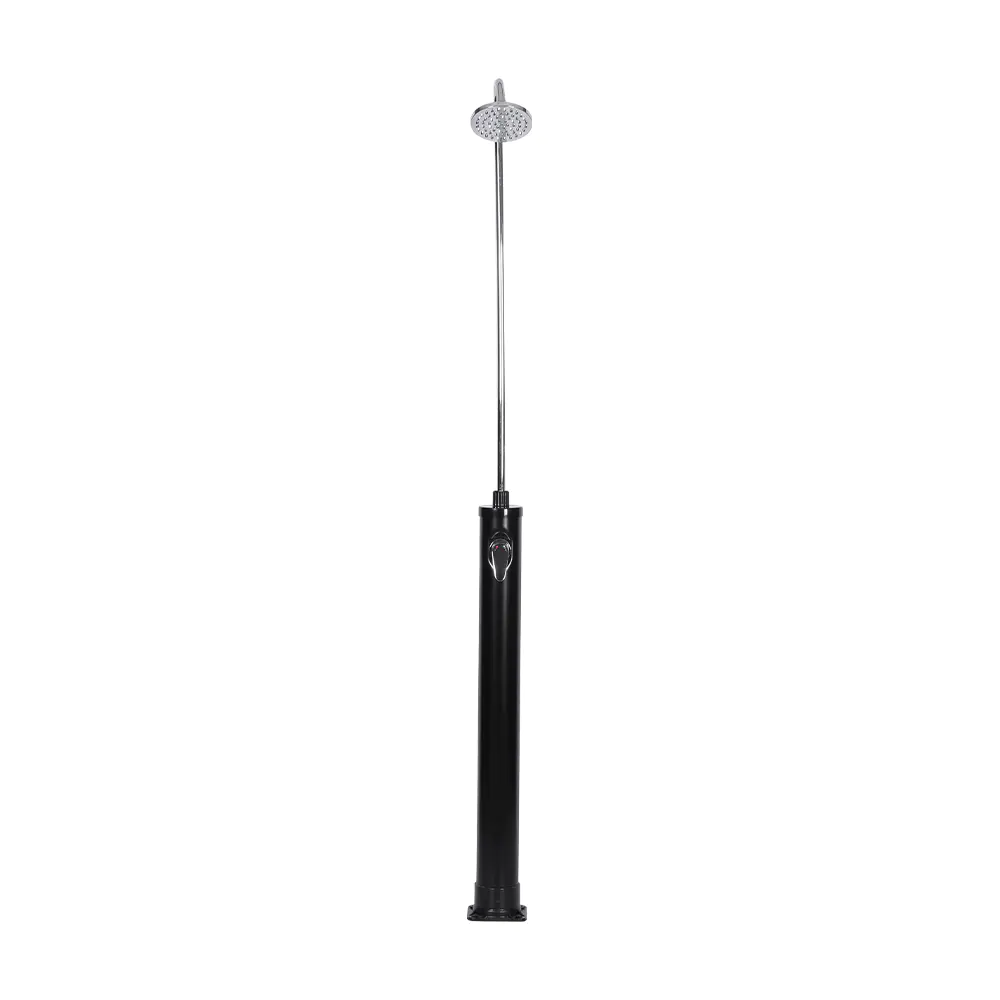 Compact 8L Outdoor Solar Garden ShowerFor quick poolside rinses or single users, this 8L column heats water up to 60°C and includes a metal mixer tap.View Product →
For a couple or a small family, the 18L column with a base plate is the balanced option. It heats to a usable 43°C by midday, holds enough water for two consecutive showers, and the weighted base keeps it stable on decking and paving. This is the capacity we ship most often to garden and pool projects in temperate markets.
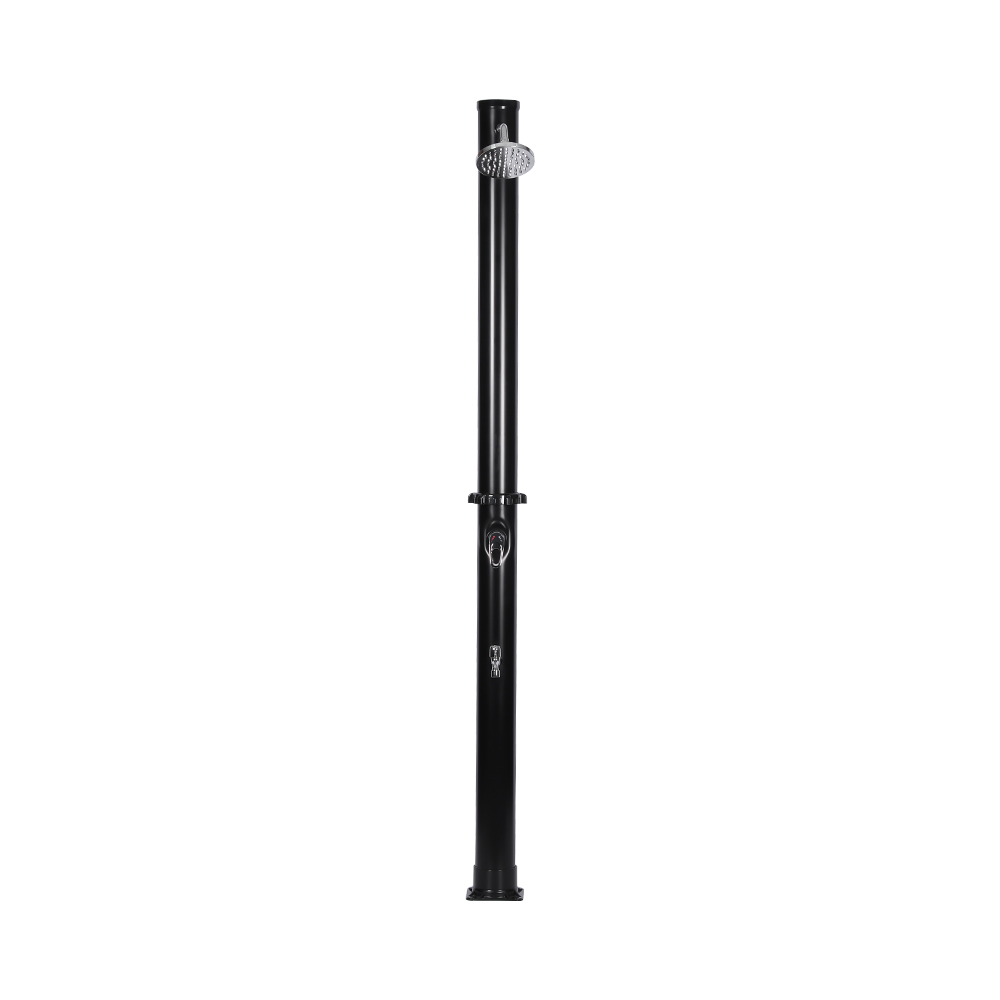 18L Outdoor Solar Shower Column with BaseThe balanced choice for couples or small families, this 18L column reaches usable 43°C by midday and has a stable base.View Product →
For households that shower in the late afternoon and want volume rather than the highest possible peak, the 35L large-capacity column is the better match. It sacrifices a few degrees at midday and returns them as usable warmth at 17:00 and 18:00, which is when outdoor showers are actually used. For a side-by-side comparison of capacities across the range, the capacity selection guide sets out the trade-offs in more detail.
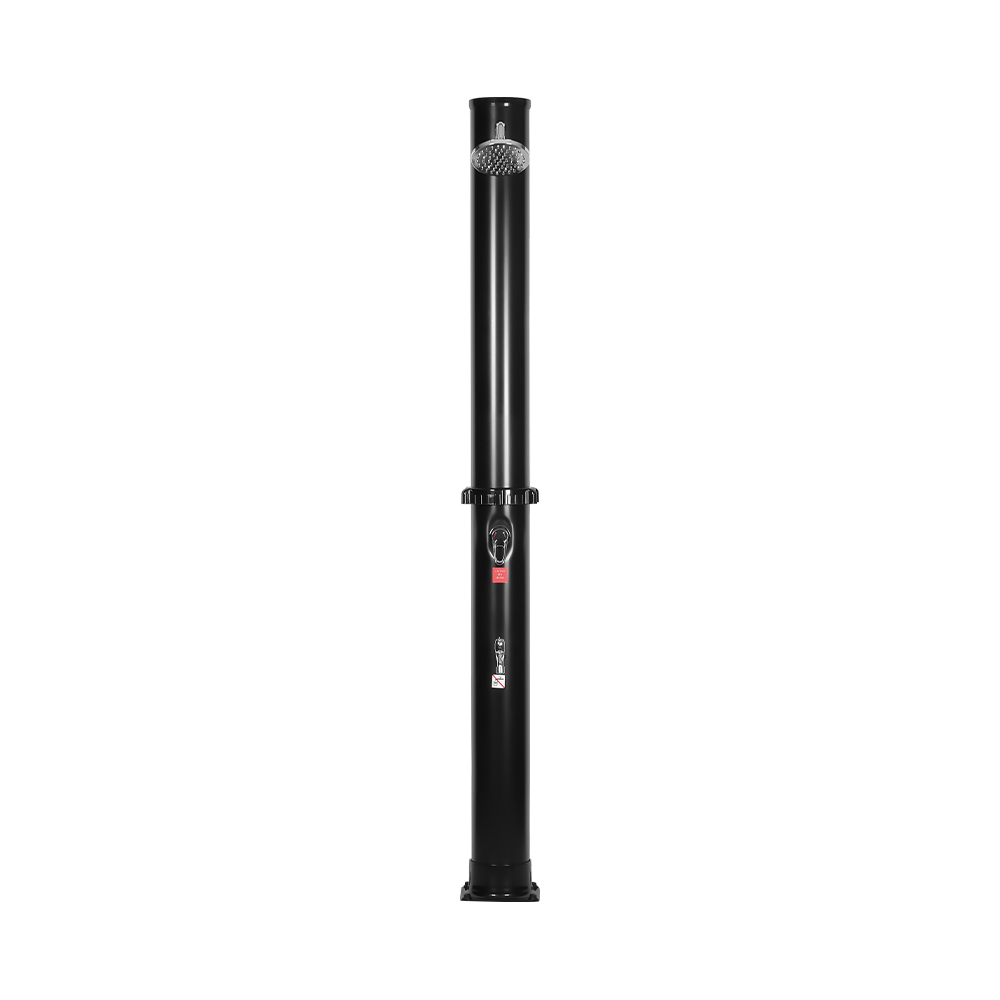 35L Large-Capacity Outdoor Solar Shower for FamiliesFor late-afternoon showers, this 35L column offers family-sized volume and can heat water to about 60°C in bright sunlight.View Product →
Weak Sun, Wind and Cold Mornings: What the Numbers Really Do
The headline range assumes decent weather. Real installations rarely get perfect conditions every day, so it helps to know how much temperature is lost when one variable turns against you.
| Condition change | Effect on peak temperature | Effect on timing |
|---|---|---|
| Thin cloud or summer haze | Minus 4 to 7°C | Peak arrives 30-60 minutes later |
| Steady wind at 15-20 km/h | Minus 5 to 8°C | Peak lower but reached at similar time |
| Air temperature 20°C instead of 30°C | Minus 6 to 9°C | Peak arrives 1-2 hours later |
| Shade from 14:00 onward | Peak never reached | Cooling begins immediately after shade |
| Tank filled only halfway | Plus 3 to 6°C | Faster rise, shorter usable supply |
| Unit moved from lawn to dark decking | Plus 1 to 3°C | Reflected heat from the surface adds a small gain |
Two of these deserve extra attention because they are easy to fix. Shade after 14:00 wipes out the entire afternoon gain on a west-facing installation, and repositioning the unit by two metres often recovers it. A half-filled tank is a legitimate tactic in shoulder seasons: a smaller volume of water genuinely heats faster, and a 30-minute shower from 12 litres at 50°C is better than a 40-minute shower from 18 litres at 42°C.
Cold mornings are a separate problem. A unit filled at 06:00 with 10°C water does not begin meaningful heat gain until the absorber surface warms, which in spring may be 09:30. Filling later is not always better, because the water itself then starts warmer only if it has been sitting in a hose. Our guidance for early-season use is to fill at mid-morning, orient the column squarely into the sun, and accept that a 35°C shower in April is a normal result, not a fault.
Frequently Asked Questions
Can a solar shower reach 60°C?
Yes, in strong conditions. A small 8L column with a large absorber area, 35°C air temperature and no wind can pass 60°C by early afternoon. Larger units rarely do, because the water volume outpaces the collector area. Treat 60°C as an upper limit reached in heatwaves and hot climates, not as an everyday expectation.
How long does it take to get hot water on a cloudy day?
Under thin cloud, expect two to three times the clear-sky heat-up time, so an 18L column that needs three hours in full sun may need six to eight hours or may never reach 40°C at all. Under solid overcast, the unit behaves as a passive insulator and gains only a few degrees above ambient.
Does the water keep heating after the sun goes down?
No. Once direct sun is gone, the tank begins losing heat, typically 4-8°C in the first hour and continuing downward through the evening. Insulated bodies and covered tanks slow this loss considerably, which is why late-evening users often choose larger capacities and add a simple cover.
Why is the first burst of water hotter than the rest?
Hot water stratifies toward the top of a vertical tank. The first litres out of a top-mounted outlet come from that warm layer, and the temperature falls as cooler water from lower down moves into the outlet. Drawing a bucket first and mixing it evens out the whole shower.
Is a higher peak temperature always better?
Not for family use. Water above 50°C must be mixed before it reaches skin, which adds a step and a risk. A steady 43-46°C outlet that holds for an hour is more useful than a 58°C spike that lasts five minutes and then needs diluting.
Does the colour of the tank really change the temperature?
Yes, measurably. Matte black and dark green surfaces absorb far more solar radiation than white or light grey, and the difference in peak water temperature between a black body and a white one of the same size can exceed 10°C. Colour is a thermal specification, not a styling choice.
What is the coldest weather in which a solar shower still works?
With air temperature around 15°C and good sun, an 18L unit will still reach 30-35°C, which is usable for a quick rinse. Below 10°C the gains shrink and heat loss grows, so the unit becomes a cold-water shower with a modest warm edge. Frost conditions require draining the unit completely to avoid split fittings.
-
How Do You Maintain and Clean Your Solar Shower for Long-Term Use
Empty the Tank After Each Use Maintaining the cleanliness and functionality of your solar shower is ...
-
Comprehensive Guide to Solar Showers: From Portable Bags to Luxury Poolside Units
Introduction to Solar Showers What is a Solar Shower? A solar shower is an innovative and environmen...
-
How to Choose the Perfect 8L Solar Shower for Beach, Pool & Garden Use
Benefits of Using an 8L Solar Shower at the Beach 1. Convenience and Portability for Beachgoers An 8...
-
The Ultimate Guide to 18L Solar Showers: Reviews, Tips, and How-To
Introduction to 18L Solar Showers In recent years, 18L solar showers have become a must-have item fo...
No.27, Fengshan Road, Hangfu Town, Kecheng District, Quzhou City, Zhejiang Province, China
(+86)-17888203192
 Wholesale Outdoor Solar Shower Factory