
 English
 Deutsch
 Español
 Français

Here You Can Get Our Latest Information
Industry News
Camping Solar Shower Sizes Compared: 8L, 18L, 30L, 35L and 60L Buying Guide
The 8L Shower Is a Rinse Tool, and That Is Its Strength
An 8L camping solar shower is not a family bathroom moved outdoors. It is a focused rinse unit for one person, a quick cool-down after a swim, or a low-weight backup for a solo trip. At a gentle 3 L/min flow, 8L delivers about 2.7 minutes of water. Drop the flow to 2 L/min and you get roughly 4 minutes. That difference matters because the shower head, not the bag alone, decides whether the experience feels rushed or usable.
The strongest use case for 8L is a beach day, a poolside rinse, or a short hike where every kilogram counts. A full 8L bag is easy to lift and hang, and it heats faster than larger volumes under the same sun because there is less water to warm. The trade-off is margin. If two people each want a full rinse, or if someone has long hair, 8L runs out before the job feels finished. Buyers should treat 8L as a personal rinse capacity, not as a group capacity. For a compact outdoor shower within a broader solar shower range, it works best when the user understands that limitation before the first trip.
8L buying check
Best for: one adult, quick rinse, beach and poolside use, small vehicles, short carry distance.
Watch for: small fittings that are hard to clean, weak hanging points, and shower heads that empty the bag too quickly.
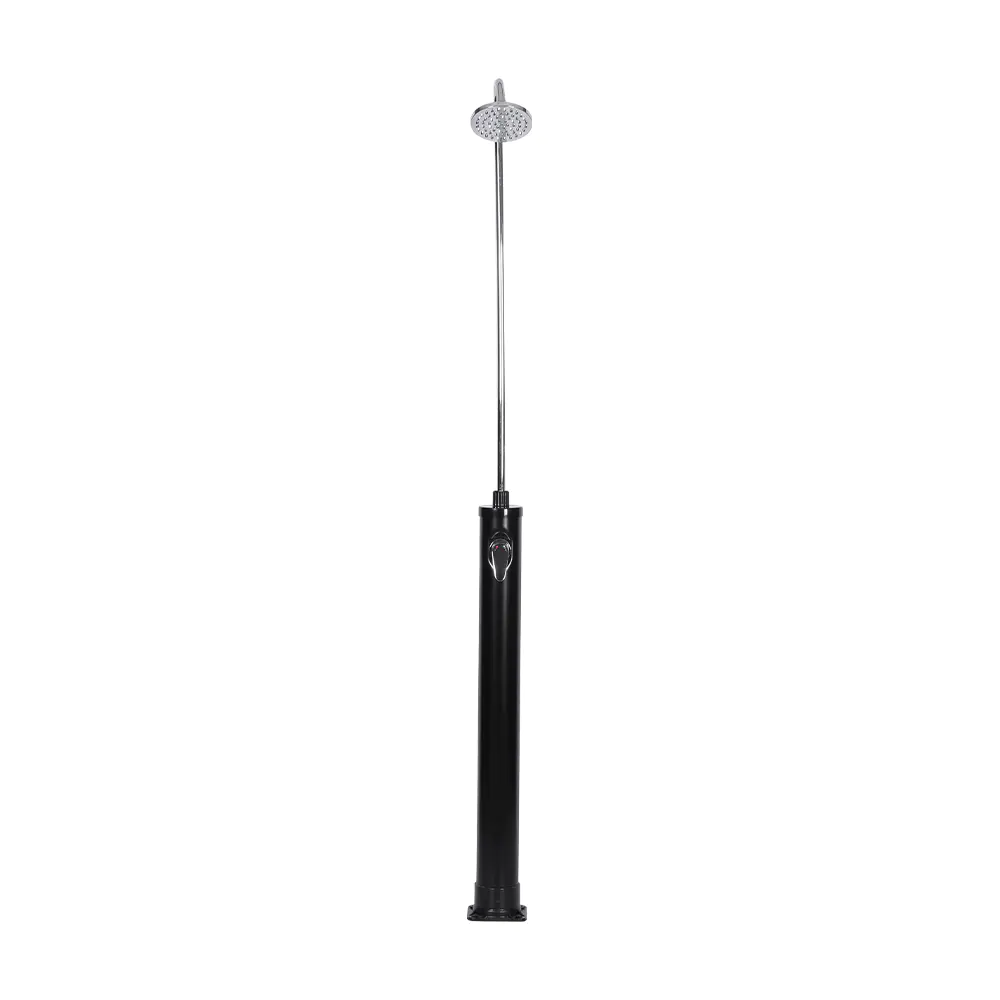 8L Solar Garden Shower with Metal Mixer TapCompact solar-heated outdoor shower for gardens, pools, and camping, featuring an 8L pipe, single-lever metal mixer, and stainless steel base.View Product →
18L Is the Couples and Small-Family Entry Point
18L is the first size that feels less like a rinse and more like a short outdoor shower. At 3 L/min, it provides about 6 minutes of water. Shared between two adults, that is roughly 3 minutes each, which is enough for a soap-and-rinse cycle if the flow is controlled. For one adult, 18L gives a more relaxed shower with time to wet down, soap up, and rinse off without constantly watching the bag empty.
This size suits weekend campers, campervan owners, and garden users who want a hot rinse without installing a permanent plumbing line. The key advantage over 8L is not just volume; it is the ability to pause. A user can wet the body, stop the flow, soap, and then rinse. That stop-start habit can turn 18L into a practical shower for two people, provided the shower head has a simple on/off control or a low-flow pattern.
Buyers should check the base and mounting method at this size. An 18L column can stand on a base, hang from a bracket, or use a freestanding frame. A stable base matters more than a fancy shower head because a partially full column becomes top-heavy when moved. A wide base, a low center of gravity, and corrosion-resistant fixings are worth more than a decorative shape. The 18L category is also where PVC, ABS, and metal parts start to mix, so material consistency across the body, fittings, and base should be reviewed together.
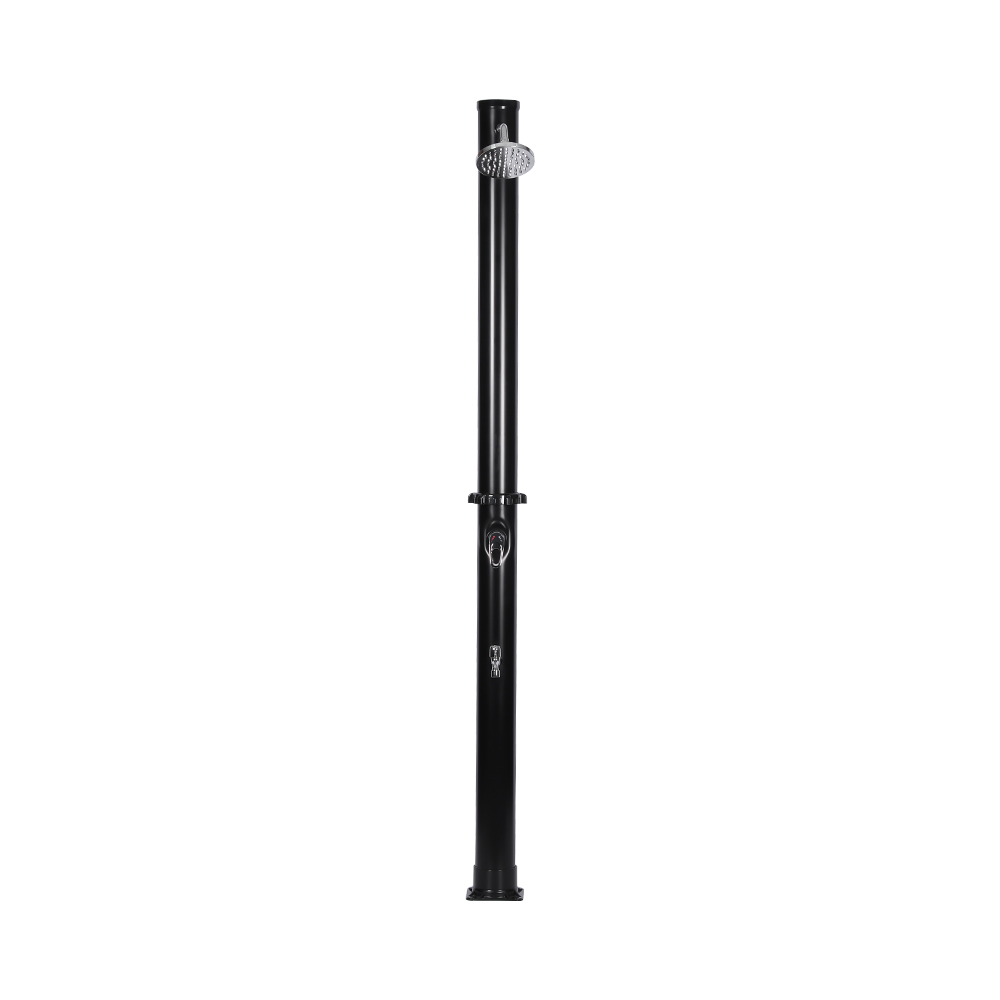 18L Solar Shower Column with PVC BaseSolar-heated outdoor shower column with 18L capacity, single-lever mixer, adjustable rain head, and stable PVC base for gardens and campsites.View Product →
30L and 35L: The Practical Middle for Families and Base Camps
30L and 35L are close in number but different in use. A 30L shower at 3 L/min gives about 10 minutes of water. At 4 L/min, it gives 7.5 minutes. A 35L unit gives about 11.7 minutes at 3 L/min or 8.75 minutes at 4 L/min. The extra 5L is not dramatic on paper, but it creates a useful buffer for a family with children, a couple who both want a full shower, or a camper who wants to wash hair without rushing.
For a family of four with short rinses, 30L to 35L is the most balanced choice. Two adults can take quick showers, and two children can be rinsed with a shared low-flow head. For a base camp with three to four adults, 35L is more forgiving because it allows one longer shower or several shorter ones. The larger volume also gives more thermal inertia: water temperature drops more slowly when the sun goes behind a cloud, though the starting temperature may take longer to reach.
The real decision between 30L and 35L is structural. A 30L column may be easier to move and store, while a 35L model often adds a larger shower head, a stronger base, or a more stable frame. If the shower will stay in one garden or campsite for days, the 35L advantages are worth it. If it will be lifted onto a roof rack or carried short distances every day, the 30L may be easier to live with. Look at empty weight, full weight, base footprint, and the height of the shower head before choosing between them.
Quick comparison
30L: about 10 minutes at 3 L/min; good for couples, small families, and short camp showers.
35L: about 11.7 minutes at 3 L/min; better for families with children, longer hair, and shared use.
Shared limit: both sizes need flow control. A high-flow head can turn a 35L unit into a 6-minute shower.
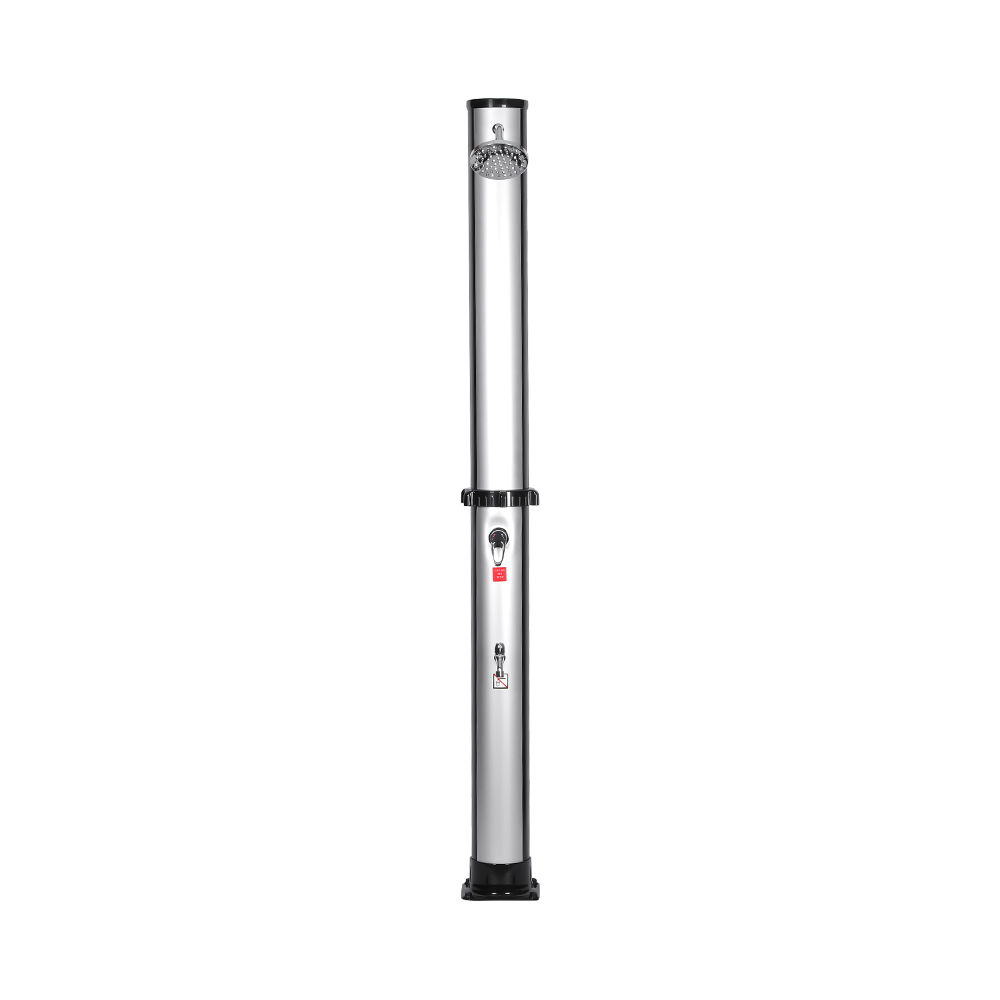 35L Adjustable Waterproof Solar ShowerFamily-size outdoor solar shower with 35L capacity, adjustable rainforest-style spray, metal soap tray, and bottom drain for gardens, pools, and camping.View Product →
60L Is for Groups, Rentals, and Long Stays
A 60L solar shower is a different category of product. At 3 L/min, it provides about 20 minutes of water. At 4 L/min, it still gives 15 minutes. That is enough for a group of four to six people taking short rinses, or for a poolside shower that sees repeated use through the afternoon. The size also makes sense for holiday rentals, campsites, and outdoor venues where guests expect a real shower rather than a token rinse.
The cost of that capacity is weight and heat time. A full 60L unit is heavy, and the mounting point must be chosen with care. It should not be hung from a weak fence or a thin branch. A stable base, a solid wall bracket, or a reinforced frame is essential. Heating also takes longer because the volume is larger. Under strong sun, a 60L unit may need most of a day to reach a comfortable temperature, especially if the starting water is cold or the unit is partly shaded.
For buyers, 60L is less about portability and more about placement. It belongs beside a pool, a cabin, a beach house, or a fixed campsite. If the user plans to move the shower every day, 60L will feel like a burden. If the shower stays in one sunny spot and serves several people, the capacity pays back in fewer refills and less waiting between users.
Capacity to Shower Minutes: A Realistic Table
The table below uses simple arithmetic, not marketing claims. Shower time depends on flow rate, so the same 18L bag can feel generous at 2 L/min and short at 4 L/min. Use the table to compare capacities, then check the shower head and valve on the actual product.
| Capacity | At 2 L/min | At 3 L/min | At 4 L/min | Most realistic use |
|---|---|---|---|---|
| 8L | 4.0 min | 2.7 min | 2.0 min | One-person rinse, beach, poolside |
| 18L | 9.0 min | 6.0 min | 4.5 min | Couple or one relaxed shower |
| 30L | 15.0 min | 10.0 min | 7.5 min | Small family, weekend camp |
| 35L | 17.5 min | 11.7 min | 8.8 min | Family with children, longer hair |
| 60L | 30.0 min | 20.0 min | 15.0 min | Group use, rental, poolside |
Heat Time Is Not Just About Liters
Larger capacity does not automatically mean slower heating in every design, but it usually means more water to bring up to temperature. A black PVC bag with a large sun-facing surface can heat efficiently because the water is spread thin. A rigid column may heat more slowly if the body is thick, insulated, or partly shaded. The variables that matter most are surface area, wall thickness, starting water temperature, air temperature, wind, and sun angle.
In strong summer sun, a small 8L bag may reach a comfortable temperature in two to three hours. An 18L to 35L unit may need three to five hours. A 60L unit may need most of a day. These are not fixed numbers. A cool morning, a windy ridge, or a shaded campsite can add hours. A unit filled with cold well water will take longer than one filled with water that has already been sitting in a sunny container.
The practical habit is to fill early, face the collector toward the sun, and rotate the unit as the sun moves if the design allows it. Do not rely on a single midday test. A shower that is hot at 2 p.m. may be lukewarm at 6 p.m. if the air cools quickly. For group use, a 60L unit should be filled before breakfast if it is needed in the late afternoon.
Temperature reality check
A solar shower is not a thermostatic appliance. It provides warm water under good conditions, not a guaranteed temperature. Users should always test the water before showering, especially with children, and mix if the unit becomes hotter than expected.
Flow Rate and Shower Head Choice Change the Verdict
Two 30L showers can behave like different products if their shower heads are different. A wide rain head with large openings can dump water quickly and feel luxurious for three minutes. A smaller head with a narrower orifice stretches the same water across a longer rinse. Neither is wrong; they serve different users. The buyer's job is to match the head to the intended shower length.
Gravity systems also lose pressure as the bag empties. The first minute may feel stronger than the last. A shower head that works well at low pressure is more useful than one that only performs at full lift height. Users should hang the bag or column as high as the structure safely allows, keep the hose free of kinks, and clean the head openings regularly. Mineral buildup can turn a good flow into a weak trickle.
For families, a simple on/off valve is a small feature with a large effect. It allows wetting, stopping, soaping, and rinsing without wasting water. For solo campers, a low-flow head is often enough. For poolside use, a broader spray may be preferred because the user is rinsing chlorinated water rather than taking a long soap shower.
Portability, Weight, and Installation by Size
Portability is where the capacity comparison becomes physical. An 8L bag may weigh under 1 kg empty and is easy to pack. An 18L rigid column may weigh several kilograms empty and more when full. A 30L or 35L unit often needs a base, a bracket, or a frame, and a 60L unit should be treated as semi-fixed equipment. Buyers should compare empty weight, full weight, packed length, and base footprint, not just liters.
Installation requirements also scale. Small bags can hang from a tree, a vehicle rail, or a temporary stand. Rigid columns need a flat surface or a secure wall. Larger units need a stronger fixing point and enough clearance for the shower head. If the product is sold with a base, check whether the base can be filled with water or sand for stability. If it is sold without a base, confirm that the mounting hardware matches the wall or ground condition.
For seasonal use, storage matters. A rigid column takes up more space than a folded bag, but it may be quicker to set up. A bag is easier to carry but more vulnerable to abrasion and UV exposure over time. The best size is the one the user will actually transport and install without dreading the task.
Vehicle camping
18L to 35L is the useful range. It stores easily, heats in a few hours, and supports two to four short showers.
Fixed garden or pool
30L to 60L makes more sense. The unit can stay in the sun, and capacity reduces refill interruptions.
Solo and beach
8L to 18L is enough. Prioritize low weight, a stable hanging point, and a simple valve.
Material and Structure: What to Inspect Beyond Capacity
PVC bags are flexible, packable, and usually lower in weight. They suit occasional use and small volumes. Rigid PVC columns offer more structure and often include a base or bracket. ABS parts are common in shower heads and fittings because they resist impact and can be chrome-plated. Aluminum frames reduce weight but need proper wall thickness and corrosion protection. Stainless steel bases add stability but increase cost and weight.
UV resistance is a key check for any outdoor shower. A product that sits in the sun for months will degrade faster if the polymer is not stabilized. Look for UV-proof or UV-resistant wording, but also inspect the wall thickness, seams, and hose connections. A thick body with poor seams may fail sooner than a thinner body with good welding or bonding. For long-term use, a regular cleaning and maintenance routine matters as much as the original material choice.
Small parts deserve attention because they cause most user complaints: the valve, the hose connector, the shower head threads, the base fitting, and the hanging strap. These parts should be easy to replace and resistant to scale. A simple product with standard fittings is often more serviceable than a complex one with proprietary parts.
Choosing by Group Size and Camping Style
Start with the number of showers between refills, not the number of people at the campsite. Two adults who shower once each need more water than four people who only rinse off after a swim. A family with young children needs a lower flow and a stable base more than a large rain head. A solo camper who wants a full hair wash may prefer 18L over 8L even though the group size is one.
Use this rule of thumb: allow 6L to 10L per short shower for adults, and 4L to 6L per child rinse. Then add a buffer for hair, dishes, or rinsing gear. That puts a solo weekend at 18L, a couple at 30L, a family of four at 35L, and a group of five or more at 60L. These are planning numbers, not guarantees. A low-flow shower head can make a smaller size work; a high-flow head can make a larger size feel small.
Finally, consider the refill source. A 60L unit is only useful if the user can refill it easily and safely. A remote campsite with a long walk to water may favor two 30L units over one 60L unit because each container is easier to carry. A poolside setting with a tap nearby can use 60L without effort.
Frequently Asked Questions
How many liters do I need for one camping shower?
For a quick rinse, 8L to 18L is enough. For a full soap-and-rinse shower with hair washing, 18L to 30L is more comfortable. The exact number depends on flow rate and how long the water is left running.
Is 8L too small for two people?
Yes, for two full showers. At 3 L/min, 8L gives about 2.7 minutes total. Two people would get very short rinses. Use 18L or more if two people need to shower between refills.
Is 30L or 35L better for a family?
35L is usually more forgiving for a family with children because it provides a little more buffer for hair and shared use. 30L is still workable if the shower head is low-flow and users take short showers.
Does a larger solar shower heat more slowly?
It often does, because there is more water to warm. Design matters too. A large bag with a wide sun-facing surface may heat faster than a thick rigid column of the same capacity. Sun, wind, and starting water temperature also play major roles.
How long does a solar shower take to heat?
In strong sun, small bags may reach a comfortable temperature in two to three hours. Mid-size units often need three to five hours. A 60L unit may need most of a day. Cool, windy, or shaded conditions can extend these times significantly.
Can I use a solar shower in cloudy weather?
Yes, but expect warm water rather than hot water. Diffuse light still carries energy, but heating is slower. If the sky is heavily overcast, the shower may only reach a mild temperature.
What flow rate should I look for?
Gravity systems commonly run in the 2 L/min to 4 L/min range. Lower flow stretches the water supply; higher flow feels stronger but empties the bag faster. A simple on/off valve is more useful than a very wide head for most camping users.
Is a 60L solar shower portable?
It is movable, but not truly portable for daily carrying. A full 60L unit is heavy and needs a strong mounting point. It suits a fixed campsite, poolside, cabin, or rental property better than a hike-in trip.
How do I keep the shower stable?
Use a wide base, fillable base, or secure wall bracket. Keep the center of gravity low, avoid hanging a large unit from a weak branch, and check the footing after the unit is full. Stability is more important than shower head size.
How should I maintain a solar shower?
Rinse the bag or column after use, drain it before storage, clean the shower head openings, and check the hose and valve for scale or cracks. In freezing weather, drain all water to avoid damage. Store the unit out of direct sun when it is not in use.
-
How Do You Maintain and Clean Your Solar Shower for Long-Term Use
Empty the Tank After Each Use Maintaining the cleanliness and functionality of your solar shower is ...
-
Comprehensive Guide to Solar Showers: From Portable Bags to Luxury Poolside Units
Introduction to Solar Showers What is a Solar Shower? A solar shower is an innovative and environmen...
-
How to Choose the Perfect 8L Solar Shower for Beach, Pool & Garden Use
Benefits of Using an 8L Solar Shower at the Beach 1. Convenience and Portability for Beachgoers An 8...
-
The Ultimate Guide to 18L Solar Showers: Reviews, Tips, and How-To
Introduction to 18L Solar Showers In recent years, 18L solar showers have become a must-have item fo...
No.27, Fengshan Road, Hangfu Town, Kecheng District, Quzhou City, Zhejiang Province, China
(+86)-17888203192
 Wholesale Outdoor Solar Shower Factory