
 English
 Deutsch
 Español
 Français
Here You Can Get Our Latest Information
Industry News
Do Solar Showers Work in Winter? Real Data, Freeze Risks, and Cold-Weather Tips
At 8 a.m. on a clear January morning in southern Germany the air sits at 2 °C, and the water inside an outdoor solar shower column is barely warmer. By 1 p.m. that same 35-litre unit can deliver water at 14 to 18 °C. Two weeks later, on a mild February day with 6 °C air and unbroken sun, the same shower reaches 20 to 24 °C. Leave it under two days of thick cloud at 3 °C and it will not get past 8 °C.
That range is the real answer to the question of whether solar showers work in winter. Yes, they work, but they work inside a narrow window set by four things: direct sunlight for at least four hours, enough water volume to store heat, air temperature that stays above roughly minus 5 °C while you use it, and a routine that removes standing water before any night that drops below freezing.
A solar shower is a passive device. There is no heating element, no pump, no thermostat and no backup power. Every degree of warmth comes from sunlight absorbed by a dark surface and from the air surrounding the tank. Winter performance is therefore a range rather than a simple yes or no, and that range is wide. The sections below show where a typical unit lands in cold weather, which parts break first when water freezes inside it, and which design details separate a shower that survives a cold season from one that cracks in the first hard frost.
The Short Answer: Four Conditions That Decide Winter Performance
When all four conditions below are met, a solar shower delivers a comfortable short shower in winter. When one of them fails, output drops sharply and the unit becomes a rinsing device rather than a shower.
Direct sun, not a bright sky
Beam sunlight is the fuel. Under a uniform overcast sky a solar shower collects roughly 20 to 30 percent of what it collects under clear sun, which is usually not enough to overcome heat loss through the tank walls.
18 litres or more
A small 8-litre tank has a high surface-area-to-volume ratio. It heats quickly in summer and loses heat just as quickly in winter. For cold-weather use, 18 to 35 litres is the practical band, and 60 litres suits several users in sequence.
Air above minus 5 °C
The tank absorbs heat from the air as well as from the sun. At minus 10 °C, heat lost to the surrounding air can cancel out most of the solar gain during a short winter day.
A freeze routine
The tank itself is rarely the weak point. The shower head, valve threads and lower joints trap water. Draining and tilting after each use is what prevents frost damage.
Put together, those conditions describe a clear winter day between roughly 10 a.m. and 3 p.m. in a sheltered, sunny position. That is the window in which a solar shower is genuinely useful between November and March in a temperate climate. Outside that window it still works, but the water it produces is closer to a cold rinse.
How a Solar Shower Actually Heats Water in Low Sun
Three heat paths run at the same time inside a solar shower. The first is direct absorption: the dark outer wall of the column or bag takes in solar radiation and passes it through the wall into the water. The second is a greenhouse effect inside the tank, where short-wave sunlight passes through the upper surface and warms the dark interior while part of the re-radiated heat stays trapped. The third is ambient exchange, where the water slowly moves toward the temperature of the air around the tank. In a mild winter that third path helps; in a hard frost it works against you.
Sun angle matters more than most buyers expect. In December the sun sits low, and the beam arrives at a glancing angle to a vertical column. A 35-litre unit that reaches 52 to 56 °C in July at 27 °C ambient will typically land at 14 to 18 °C in January at 2 °C ambient on a clear day, and at 7 to 10 °C on a grey one.
Typical midday rise above ambient air, 35-litre freestanding column
Approximate values for a temperate climate, clear sky, wind under 15 km/h, water filled at 9 a.m. Real results shift with latitude, shading, column material and water volume.
Two conclusions follow. First, a solar shower never has to hit a fixed number to be useful; it only has to beat ambient air by enough to make a shower tolerable. Second, the winter gain over ambient is smaller in absolute terms, which is why a larger water volume and a sheltered position matter far more in January than they do in July.
What Changes in Winter: Sun Angle, Daylight and Air Temperature
Almost all of the seasonal drop comes from three physical changes.
- Sun elevation. At 50° latitude the noon sun stands about 63° high in June and only about 16° in December. Low sun means a longer path through the atmosphere, more scattering and less energy per square metre of absorber surface.
- Daylight length. Shorter days give the tank fewer collection hours, so a fill at 9 a.m. has to carry the whole day.
- Air temperature. Cooler air increases losses from the tank surface, the shower head and any exposed hose.
| Location (latitude) | Noon sun elevation | Daylight hours | Daily solar energy | Water at 2 p.m. in a 35 L column |
|---|---|---|---|---|
| Southern Spain (37°N) | About 29° | 9.7 | 2.5 to 3.0 kWh/m² | 22 to 28 °C |
| Central Italy (42°N) | About 24° | 9.1 | 2.0 to 2.5 kWh/m² | 19 to 25 °C |
| Southern Germany (48°N) | About 19° | 8.4 | 1.0 to 1.5 kWh/m² | 14 to 19 °C |
| Northern Germany or UK (52°N) | About 15° | 7.8 | 0.7 to 1.1 kWh/m² | 11 to 16 °C |
| Southern Sweden (57°N) | About 10° | 6.8 | 0.4 to 0.8 kWh/m² | 8 to 13 °C |
As a working rule, the rise above ambient air on a clear winter afternoon is roughly 50 to 70 percent of the summer rise. If your unit gains 25 °C over air temperature in July, expect 12 to 18 °C over air temperature in December. That is why a midsummer reading of 55 °C becomes 15 to 20 °C in January rather than 40 °C. Anyone promising summer temperatures in December is selling something other than physics.
Realistic Winter Scenarios: What You Will Actually Feel
The numbers below come from the same 35-litre freestanding column in a sheltered, south-facing position, filled at 9 a.m. and used in the early afternoon.
| Scenario | Air temperature | Water at 2 p.m. | What it feels like |
|---|---|---|---|
| Clear sun, still air | 6 °C | 20 to 24 °C | Cool but genuinely usable for a short shower |
| Clear sun, 25 km/h wind | 6 °C | 15 to 18 °C | Brief rinse; wind strips heat from the column wall |
| Hazy sun, thin cloud | 7 °C | 12 to 16 °C | Quick rinse only, no shampoo routine |
| Full overcast | 5 °C | 7 to 10 °C | Below comfort; not worth filling |
| Clear frost | minus 4 °C | 8 to 12 °C | Rinsing only, plus freeze risk in the fittings |
| Summer reference, clear | 27 °C | 52 to 56 °C | Hot enough to mix with cold water |
The pattern is consistent and slightly counterintuitive: wind and cloud cost you more than cold air does. A 6 °C day with strong wind will underperform a 1 °C day that is still and sunny. If you have one sunny, windless winter day in a month, that is the day to fill the tank.
The Freeze Problem: What Actually Breaks a Solar Shower in Winter
Water expands by about 9 percent when it turns to ice, and the force it exerts is far greater than the strength of the fittings it is trapped inside. A solar shower rarely fails because the main tank splits at the top; the tank usually has room to expand upward. It fails at the points where a small, fixed volume of water sits in a closed space.
The three failure points
- The shower head. Water rests inside the head and in the short arm behind it. A chrome-plated ABS head with a narrow spray plate is the most common casualty of a hard frost.
- Valve and thread joints. A single drop left in the thread of a plastic valve can crack the collar when it freezes.
- The column base and lowest connection. Ground contact keeps this area colder than the rest of the unit and delays the morning thaw.
How common materials behave below zero
| Material | Behaviour at low temperature | Practical note |
|---|---|---|
| PVC | Becomes brittle near 0 °C and can shatter on impact | Fine in mild frost when drained; avoid knocking a cold column |
| ABS | Retains much of its impact strength down to about minus 20 °C | Better choice for frost-prone regions, especially for heads and valves |
| Aluminium | No low-temperature embrittlement; dents rather than cracks | Good for permanent poolside and garden installations |
| Stainless steel | Highest strength, no cold brittleness | Preferred for bases, screws and mounting plates |
| Silicone and EPDM seals | Stay flexible to about minus 40 °C | Usually outlive the plastic thread around them; replace every two to three seasons |
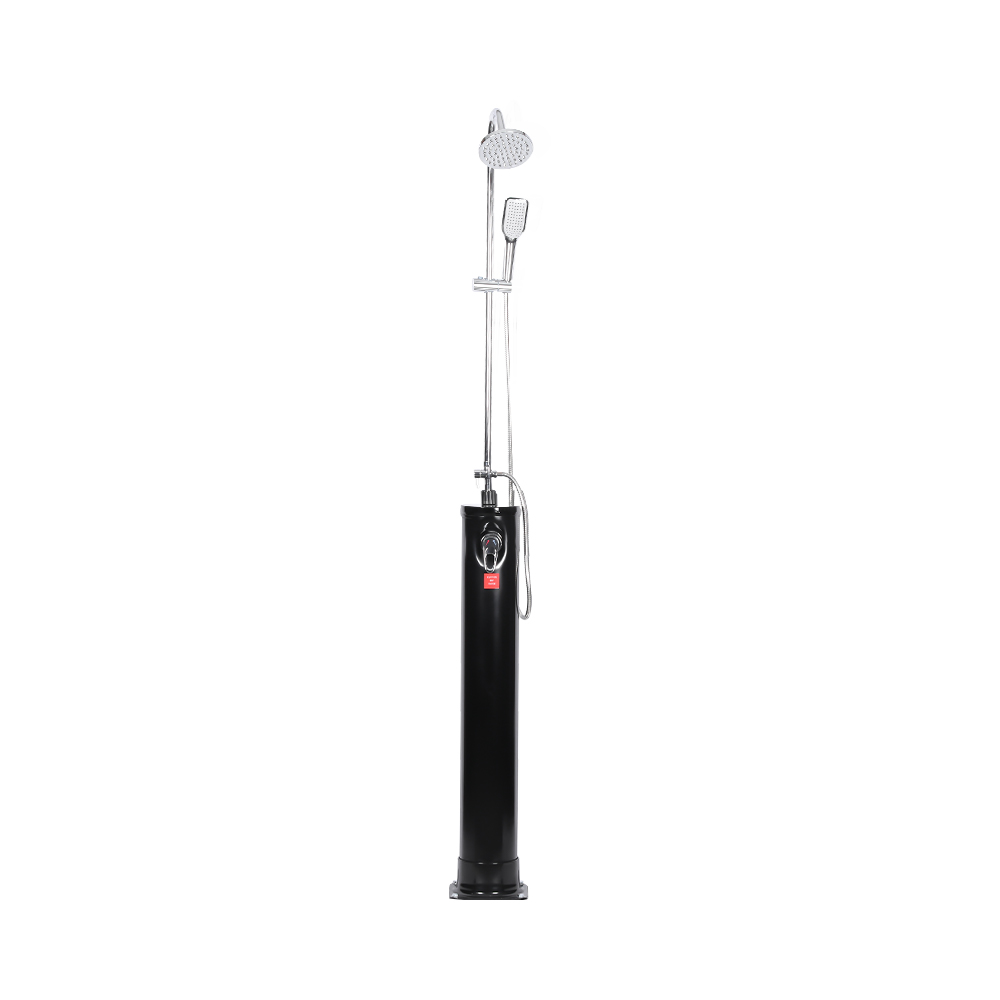
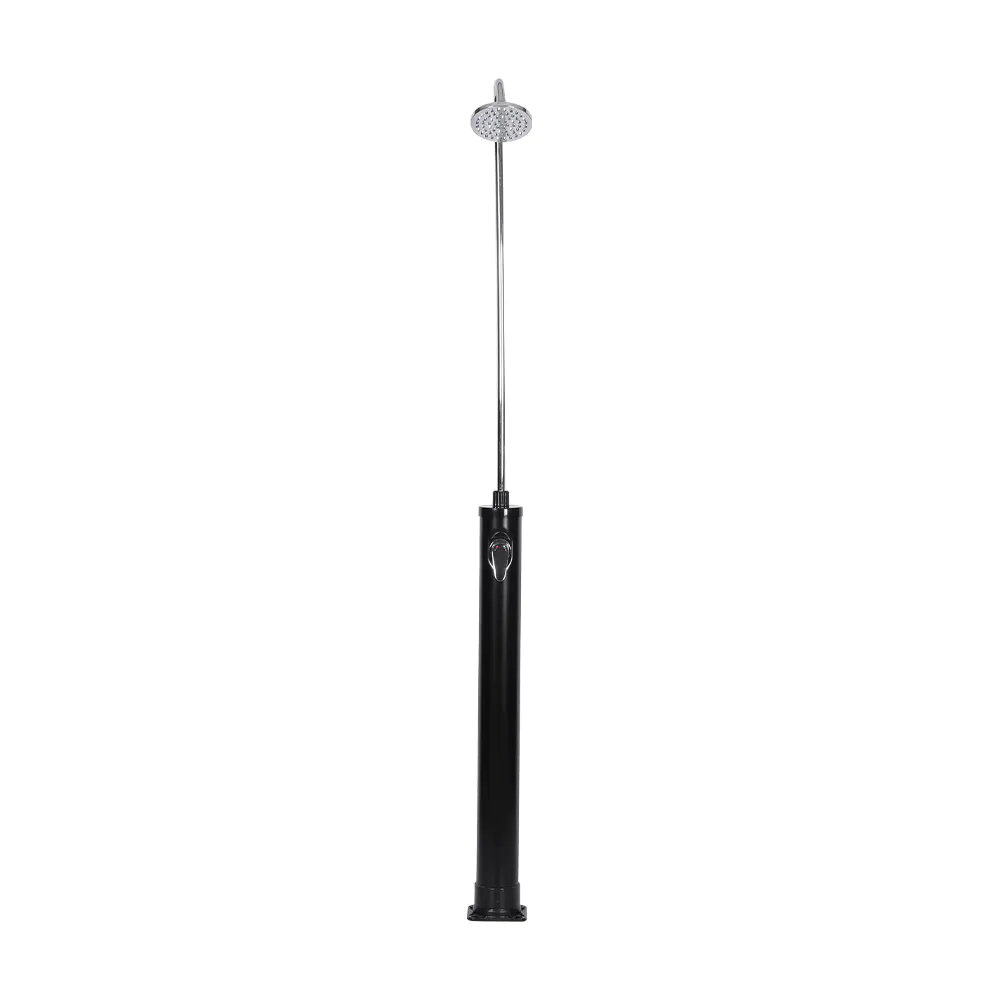
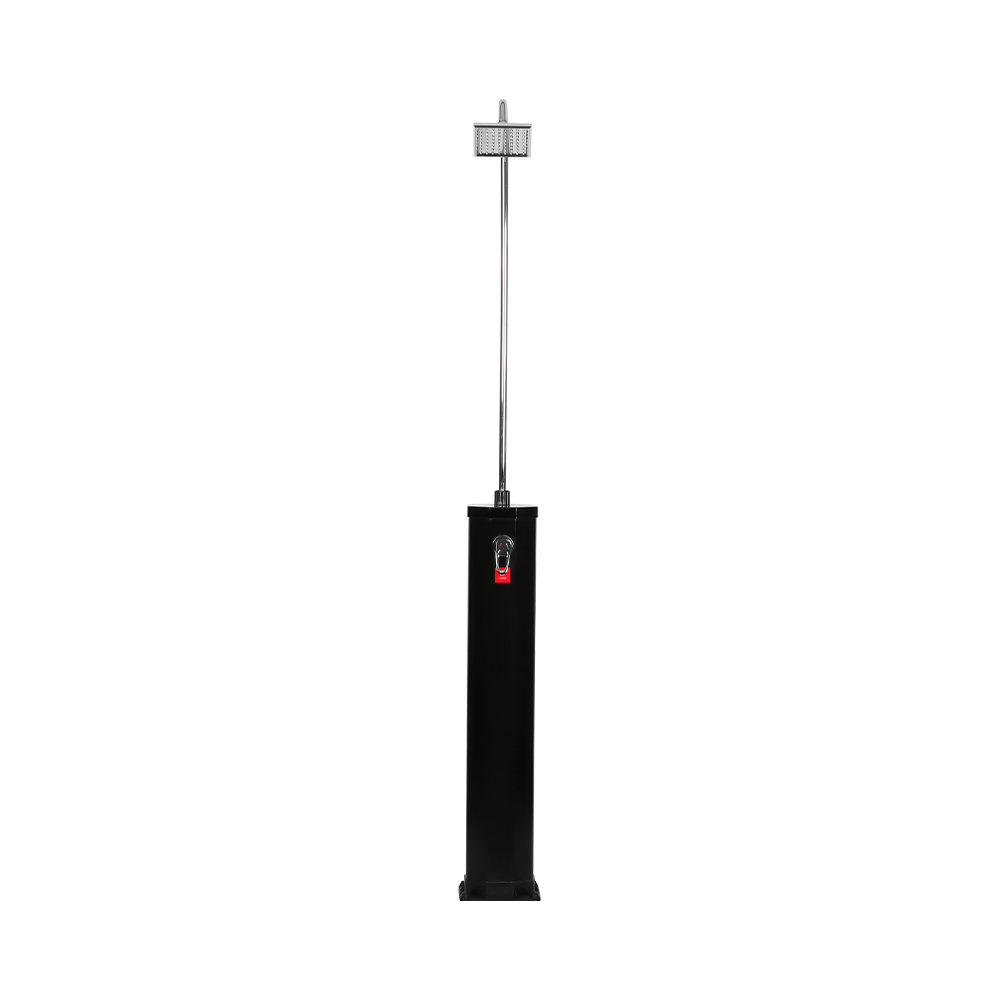
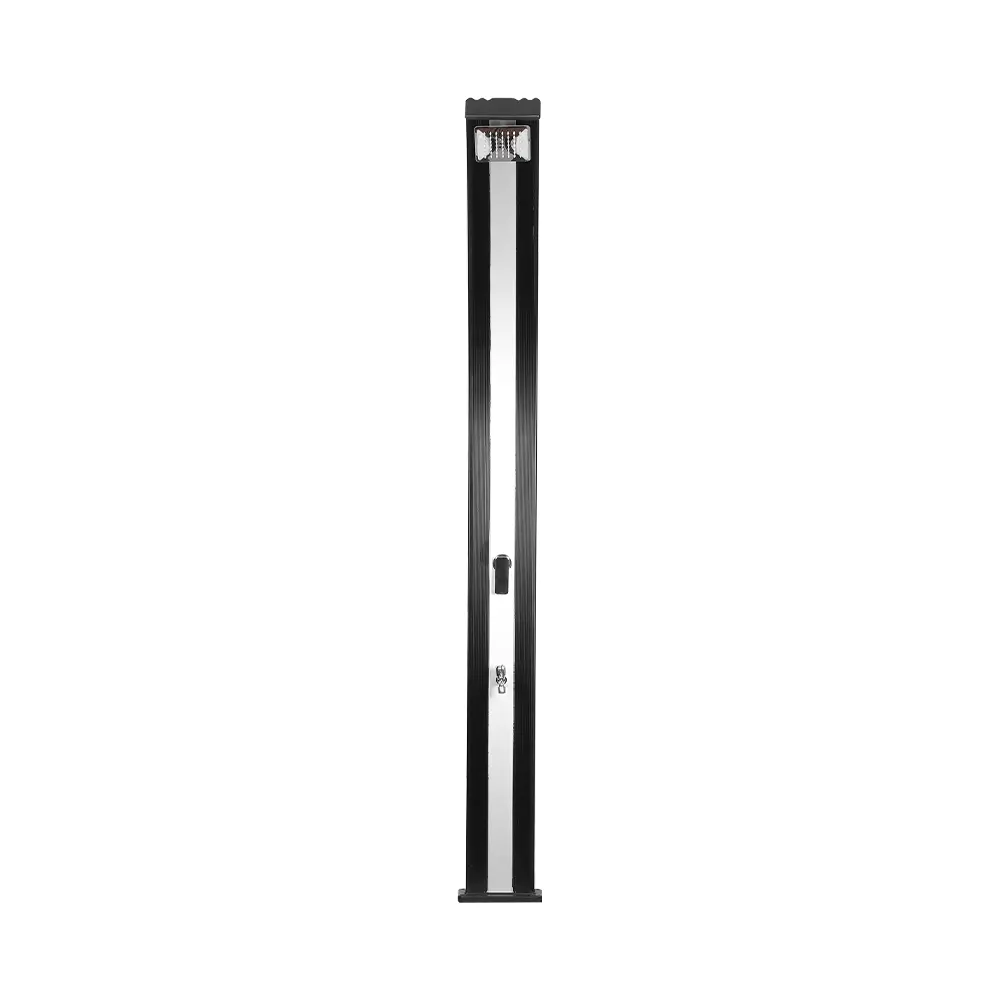
The design answer to all of this is a clear drainage path. Units built with an anti-water-accumulation base let the last half litre escape through the foot of the column instead of pooling above the base plate, and a removable head lets you shake out the water that would otherwise sit in the spray plate overnight.
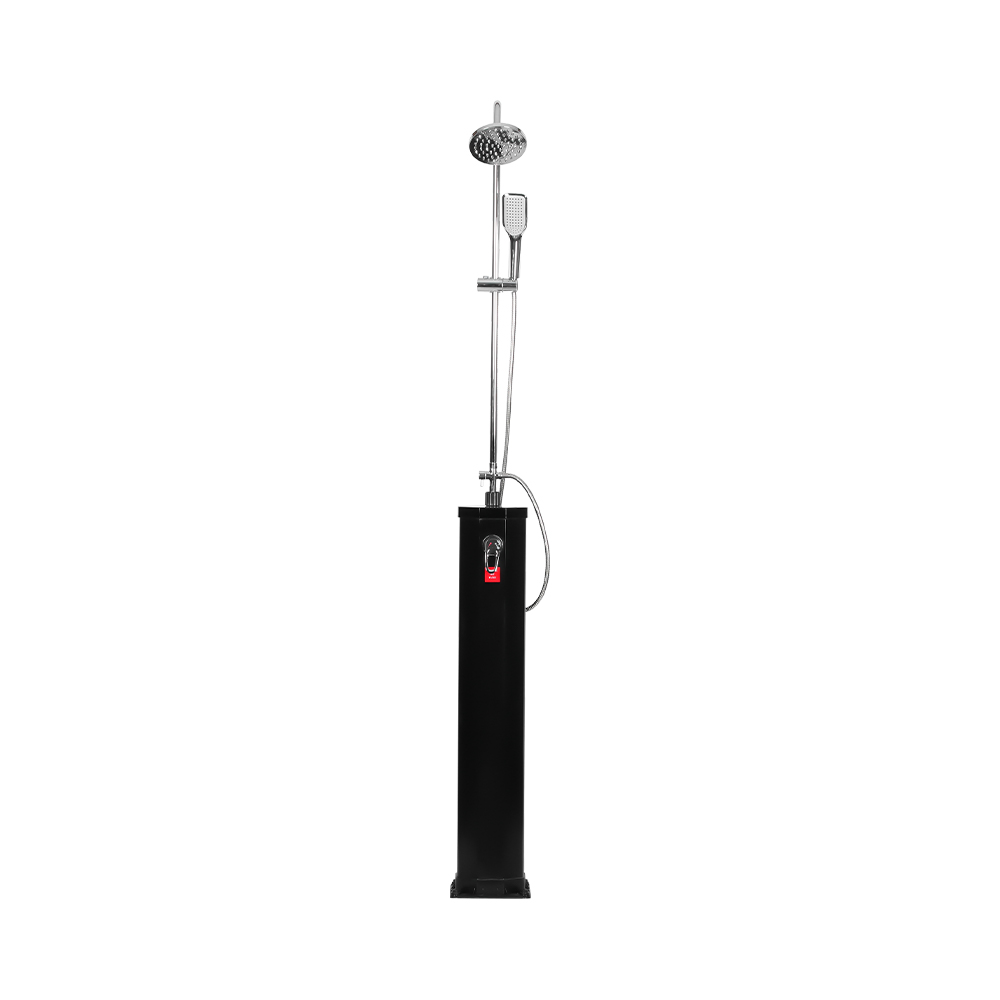
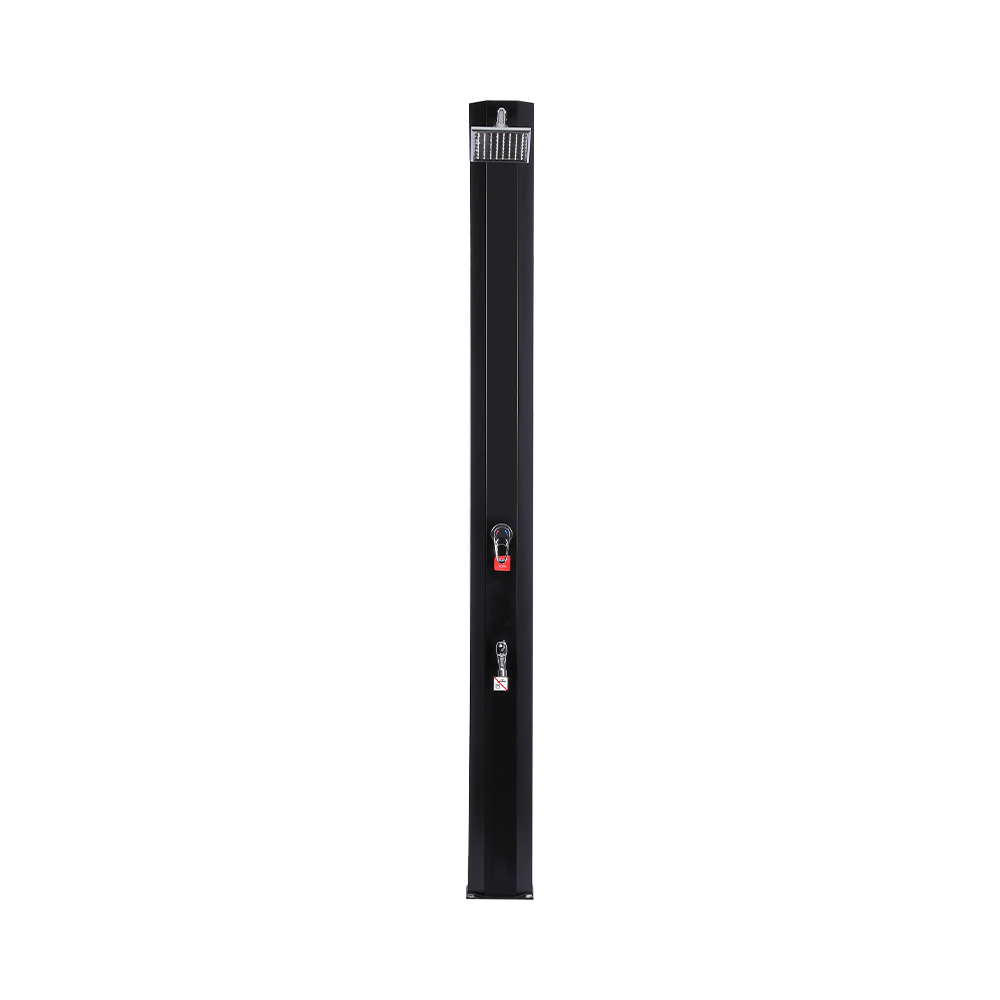 LY35L05-SS Anti-Water Accumulation Solar Shower with Drainage HolesA solar shower with anti-water-accumulation base, metal tray and drainage holes, designed to reduce pooling and support easy disassembly for compact off-season storage.View Product →
If your current shower has a closed base, one practical workaround costs nothing: disconnect the head after use, tilt the column 30 to 45 degrees for ten minutes, and store the head indoors. Owners who follow that routine report far fewer cracked valves than owners who simply leave the unit standing full.
Capacity and Thermal Mass: Why 8 Litres and 60 Litres Behave Differently
Water has a high heat capacity, about 4.18 kilojoules per kilogram per degree Celsius. A 35-litre tank therefore stores roughly 146 kilojoules for every degree it gains. That stored energy is what keeps a shower warm after the sun has moved off it, and it is why capacity matters far more in winter than in summer, when the sun keeps topping the tank up.
| Capacity | Time to gain 15 °C | Cool-down in 5 °C air after sunset | Best winter role |
|---|---|---|---|
| 8 L | 1.5 to 2 hours | Falls within 3 °C of air in 40 to 60 minutes | Day trips and quick rinses |
| 18 L | 2.5 to 3 hours | 1.5 to 2 hours | One shower in a mild winter |
| 30 L | 3.5 to 4 hours | 2.5 to 3 hours | Two people, shoulder seasons |
| 35 L | 4 to 5 hours | 3 to 4 hours | Most balanced choice for cold weather |
| 60 L | 6 to 7 hours | 5 to 6 hours | Family use or late-afternoon showers |
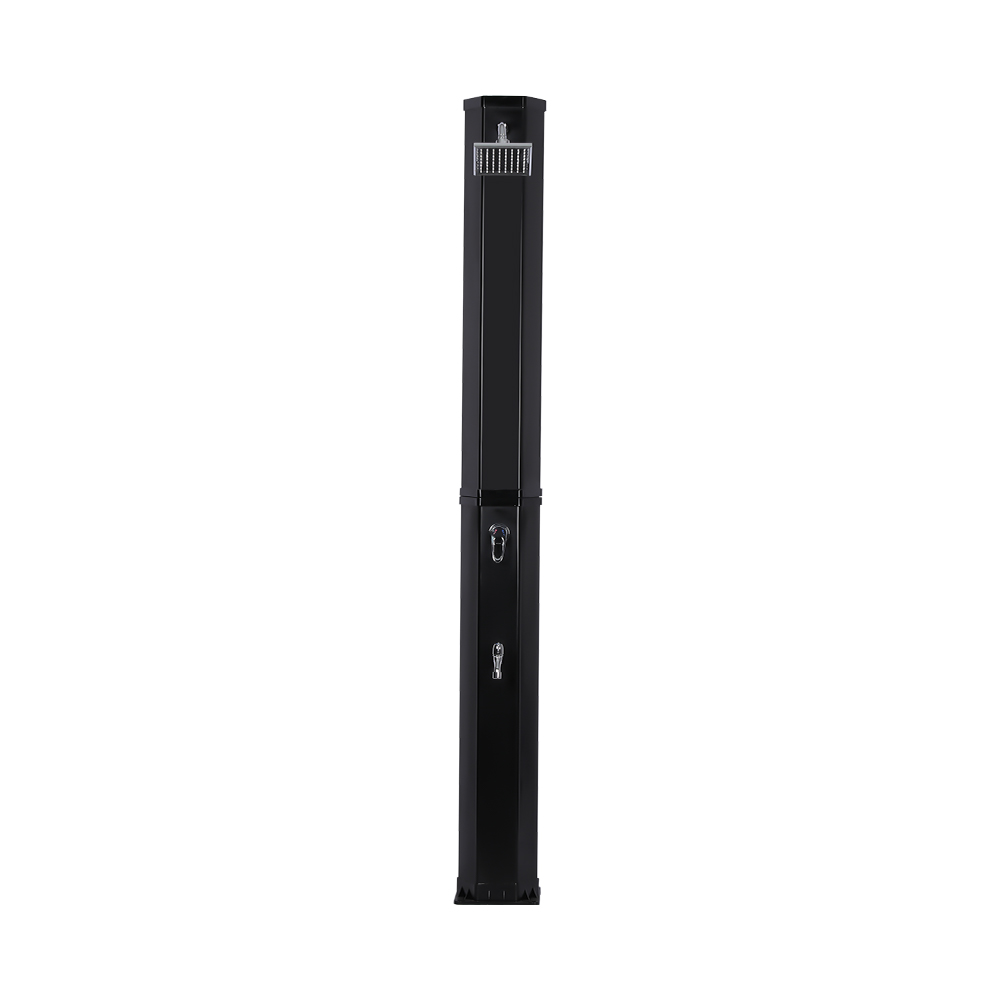 LY60L01 Extra Large Rain Shower Head Garden Solar ShowerAn outdoor solar shower with oversized rain showerhead and adjustable ball joint, built for simple installation, durable UV-resistant use and compact seasonal storage.View Product →
The counterintuitive part is that a larger tank often heats more slowly but feels warmer. A 60-litre unit may take six hours to gain 15 °C, yet it will still be 15 to 18 °C two hours after sunset, when an 8-litre unit has already dropped back to air temperature. For cold-season use, 35 litres is the sweet spot for one or two people, and 60 litres suits a family or anyone who showers after 4 p.m.
Installation Choices That Change Winter Results
Where a solar shower stands in January matters as much as which model you bought. Four installation details decide most of the outcome.
Face the equator and respect the low sun
A vertical column captures low winter sun better than a bag lying flat on the ground, because the beam strikes the tall dark face at a workable angle. If your unit has a flat panel section, tilt it 45 to 60 degrees toward the equator for the December and January sun. The most important single check is simple: nothing should cast a shadow on the tank between 10 a.m. and 2 p.m.
Shelter from wind, but never from sun
Moving air pulls heat out of the column wall far faster than still air does. A wall, hedge or fence one to two metres to windward cuts most of that loss without blocking the beam. Avoid courtyards that only see direct sun for two hours; a shaded but sheltered spot is the worst of both worlds.
Lift the unit off frozen ground
Ground contact conducts heat away and, in frost-heave soils, can shift the base and stress the column joints. A concrete pad, gravel bed, timber platform or a purpose-made shower base with 100 to 150 mm of clearance below the foot solves both problems at once and keeps the base dry.
Keep the water path short
Every extra joint, elbow or extension hose is a place where water sits and freezes. Use a straight, short connection between tank and head, and prefer quick-release fittings that can be removed and taken indoors. Fewer parts means fewer freeze points and faster winter draining.
A Practical Winter Routine, Step by Step
The difference between a solar shower that lasts eight winters and one that lasts one is a routine that takes about six minutes.
- Check the overnight forecast before filling. If the minimum is below minus 3 °C, plan to drain the same evening.
- Fill in the morning, not at noon. Water starting at 5 °C needs the full six hours of weak winter daylight; filling at 1 p.m. leaves too little time to gain anything useful.
- Position the unit square to the midday sun so the dark tank face is broadside to the beam.
- Shower between 1 p.m. and 3 p.m. This is when the water peaks and the air is warmest.
- Open the drain outlet at the foot of the column rather than emptying through the shower head; the head never drains completely.
- Disconnect the head and shake it out, then hang it upside down if the design allows.
- Tilt the empty column 30 to 45 degrees for ten minutes to move residual water out of the base.
- Take removable heads, hoses and valve handles indoors for the night.
- If a hard freeze is forecast below minus 10 °C, bring the whole unit inside, base included.
- Inspect seals, threads and the spray plate at the start of every month through winter.
Owners who clean and inspect on a fixed schedule get noticeably more seasons out of the same hardware, and the same care routine that protects valves and heads in summer also protects them in frost. A step-by-step cleaning and maintenance walkthrough is available in our solar shower maintenance guide, which covers descaling, seal replacement and storage between seasons.
Store It or Use It? A Climate-Based Decision
There is no universal winter rule. The right approach depends on how cold your nights actually get, and the three patterns below cover most markets.
Mild winters, minimum above 0 °C
- Use the shower all year.
- Drain every evening as a habit, not a precaution.
- Expect 18 to 25 °C water on clear winter afternoons.
- Inspect the shower head seal twice per season.
Moderate frost, minus 5 to minus 15 °C at night
- Use on clear, still days only.
- Fill after 9 a.m. and drain before 5 p.m.
- Store the head, hose and valve indoors overnight.
- Keep a spare seal set on the shelf.
Hard freeze, below minus 15 °C for weeks
- Drain fully and store the unit indoors.
- Dismantle the head, valve and base plate.
- Never leave water in an unheated garage or shed.
- Reassemble and pressure-check in spring.
One more consideration applies to all three: a shower that has been drained properly is also a shower that will not surprise you in March. Ice damage is almost always discovered at the first warm day of spring, when the tank holds water again and a cracked valve starts to leak.
What to Look For When Buying a Cold-Weather Solar Shower
If the unit will live outdoors through a frost season, these are the specifications worth checking before price.
| Specification | Why it matters in winter | Practical minimum |
|---|---|---|
| Capacity | More stored heat and slower cooling after the sun moves off | 18 L for one user; 35 L recommended |
| Tank and column material | Brittle plastics crack under ice expansion and impact | UV-stabilised ABS or quality PVC; aluminium for permanent sites |
| Column wall thickness | Thin walls lose heat faster and crack sooner | 2.5 mm or more on the main column wall |
| Valve type | Water trapped in a screw thread freezes and splits the collar | Quarter-turn valve with a clear drain position |
| Shower head | Pooled water in the spray plate is the first thing to crack | Removable head, or one that empties when tilted |
| Base design | Water sitting above a closed base plate has nowhere to go | Open or anti-accumulation base |
| Fasteners and fittings | Mixed metals corrode quickly in wet, freezing conditions | Stainless steel screws, brackets and base plate |
| Spare parts availability | Seals and heads wear out long before the tank does | Replaceable heads, valves and seal kits |
A low price on a thin-walled unit is rarely a saving if the shower head cracks in the first December frost, because the replacement part is often unavailable by February. Buying a model with a spare-parts path matters more in cold climates than in warm ones.
How Cold-Market Solar Showers Are Built and Tested
There is a real difference between a solar shower designed for a Mediterranean pool deck and one intended for a market where the first frost arrives in October. The difference starts with material selection: UV-stabilised ABS for heads and valve bodies, high-density PVC or aluminium for columns, stainless steel for bases and fasteners, and EPDM or silicone for every seal. Those choices cost more at the factory gate and save the end user a replacement unit within two seasons.
Wall thickness is the second variable. A column wall of 2.5 to 3.0 mm holds heat noticeably better than a 1.8 mm wall and resists ice expansion without splitting. Material weight is also a rough proxy for how much filler is in the compound, which in turn predicts how the plastic behaves after three winters of UV exposure and frost cycles.
Testing is the third. Units intended for cold regions are typically checked with thermal cycling between minus 20 °C and plus 60 °C to confirm that seals and threads survive repeated expansion and contraction, a pressure test at around 2 bar to verify joints, and a drainage test in which the unit is filled, drained and then weighed to measure how much residual water stays trapped inside. That last test is the one that predicts frost survival most accurately, because trapped water, not cold air, is what damages a shower.
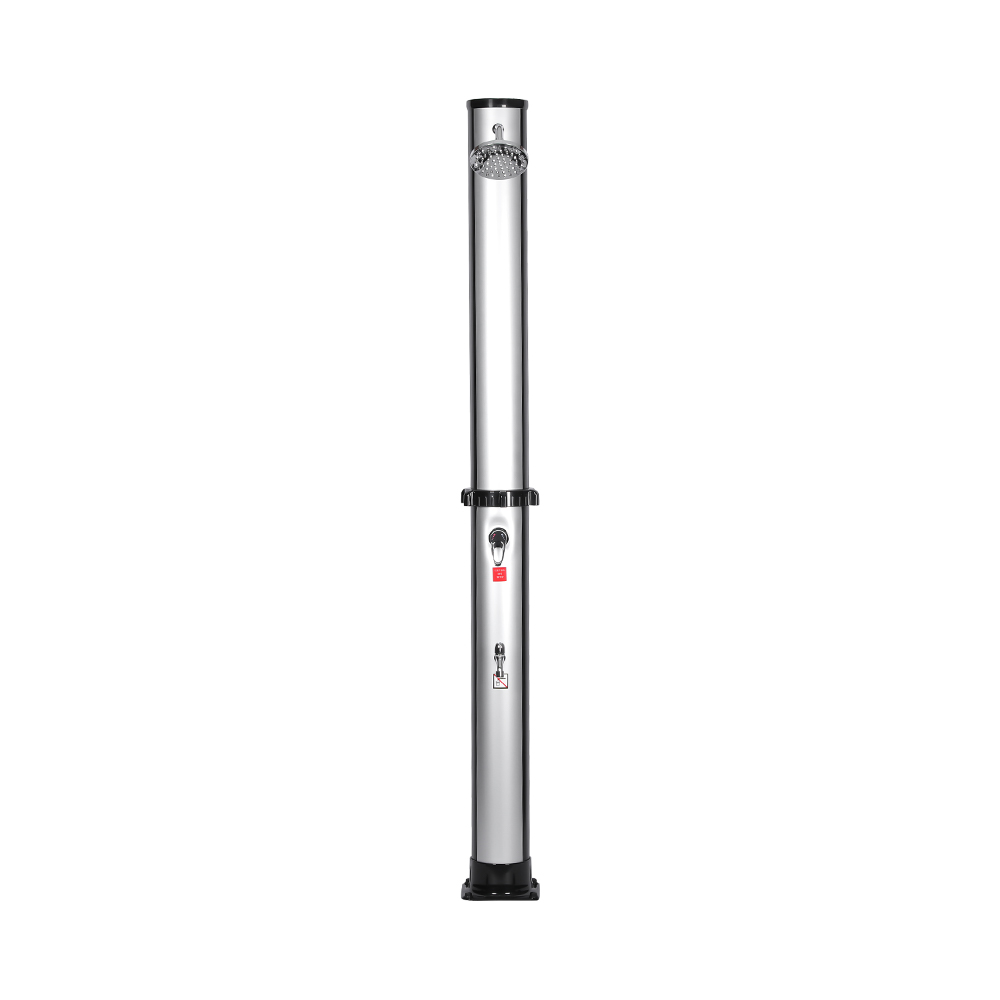 LY35L02-CR Adjustable Water-Proof Solar Shower with Drain ChannelA sunlight-heated outdoor shower with adjustable head, metal tray and drain channel that limits standing water and offers flexible flow for garden, pool or camping use.View Product →
Quzhou Haihong Electrical Equipment Co., Ltd. has manufactured outdoor solar showers, garden showers and poolside shower systems since 2010 from a 17,000 square metre production base in Zhejiang, China, with design, development and manufacturing carried out in house under ISO9001 and BSCI audited systems. Product families run from 8 litres through 18, 30, 35 and 60 litres, with matching bases and WPC mounting boards, and the range is exported to more than 30 countries. For importers and brand owners specifying products for cold regions, the working conversation usually comes down to three questions: how much water remains inside after draining, how thick is the column wall, and can the shower head and seals be replaced as service parts.
Frequently Asked Questions
Can a solar shower reach a usable temperature when the air is only 5 °C?
Yes, on a clear, still day. A 35-litre column filled at 9 a.m. and used at 2 p.m. typically reaches 20 to 24 °C at 5 to 6 °C air temperature. Add 25 km/h of wind and the same unit drops to 15 to 18 °C, which is a rinse rather than a shower.
Do I need to add antifreeze to a solar shower?
No. These are open, unpressurised tanks holding water intended for washing. Antifreeze belongs in sealed heating loops, not in a tank a person showers from. Draining is the correct protection, and it takes less than two minutes.
Will water freeze inside the tank overnight?
It can, but the tank usually survives because ice has room to expand upward in an open vessel. The parts that crack are the shower head, the valve thread and the base connection, where water is trapped in a small fixed volume. That is why draining the head and the valve matters more than draining the tank.
Does a black solar shower work better in winter than a blue or grey one?
Dark surfaces absorb more solar radiation, so a black or very dark column does outperform a light-coloured one. The gap between black and dark green is small; the gap between black and white is substantial. Colour matters less than sun angle, capacity and wind shelter.
How long does 35 litres take to heat in December?
Around four to five hours of clear sun to gain 12 to 15 °C over air temperature. That is why the fill happens in the morning and the shower happens in the early afternoon. A noon fill leaves too little daylight to work with.
Can I use a solar shower for winter camping with a shower tent?
Yes, with realistic expectations. Fill in the morning, place the tent in full sun with the tank outside it, and expect 15 to 20 °C in the afternoon. Many campers carry a small kettle of hot water to raise the temperature by 5 to 8 °C just before use, and nobody leaves water in the tank overnight.
Is a solar shower with a hose and pump better in winter?
Not automatically. Gravity-fed columns have fewer trapped volumes and drain more completely, which is an advantage in frost. A pump helps when you need pressure for a long hose run, but every extra metre of hose is another place where water sits and freezes.
What water temperature counts as comfortable for an outdoor shower?
Most people find 32 to 38 °C genuinely comfortable. Between 20 and 25 °C a short shower is tolerable in cold air, especially for rinsing after a swim or a garden session. Below 15 °C you are in cold-water territory, and it stops being a shower and becomes a plunge.
-
How Do You Maintain and Clean Your Solar Shower for Long-Term Use
Empty the Tank After Each Use Maintaining the cleanliness and functionality of your solar shower is ...
-
Comprehensive Guide to Solar Showers: From Portable Bags to Luxury Poolside Units
Introduction to Solar Showers What is a Solar Shower? A solar shower is an innovative and environmen...
-
How to Choose the Perfect 8L Solar Shower for Beach, Pool & Garden Use
Benefits of Using an 8L Solar Shower at the Beach 1. Convenience and Portability for Beachgoers An 8...
-
The Ultimate Guide to 18L Solar Showers: Reviews, Tips, and How-To
Introduction to 18L Solar Showers In recent years, 18L solar showers have become a must-have item fo...
No.27, Fengshan Road, Hangfu Town, Kecheng District, Quzhou City, Zhejiang Province, China
(+86)-17888203192
 Wholesale Outdoor Solar Shower Factory