
 English
 Deutsch
 Español
 Français
Swimming Pool Solar Shower: Complete Guide & Buying Advice
1. What Is a Swimming Pool Solar Shower?
A swimming pool solar shower is exactly what it sounds like — a standalone shower unit designed specifically for outdoor pool areas, powered entirely by the sun. No electricity, no gas, no complicated plumbing. Just fill the tank, leave it in the sun, and you've got warm water ready to rinse off before or after a swim.
The concept is straightforward: a dark-colored water tank absorbs solar radiation throughout the day, gradually warming the water inside. By the time you're ready to use it, the water is comfortably warm — sometimes surprisingly hot on a clear summer afternoon.
Why does the pool area require a dedicated solar shower?
Most pool owners eventually realize that jumping straight from the pool to an indoor shower isn't always practical — wet feet on indoor floors, chlorine tracked through the house, kids dripping everywhere. A swimming pool solar shower solves this by giving you a dedicated rinse station right at the poolside, keeping the mess outside where it belongs.
Beyond convenience, many public pools and private pool facilities require a pre-swim rinse to reduce the amount of sunscreen, sweat, and body oils that end up in the pool water. A solar shower handles this effortlessly.
Common Types of Swimming Pool Solar Showers
There are three main configurations you'll come across, each suited to different pool setups:
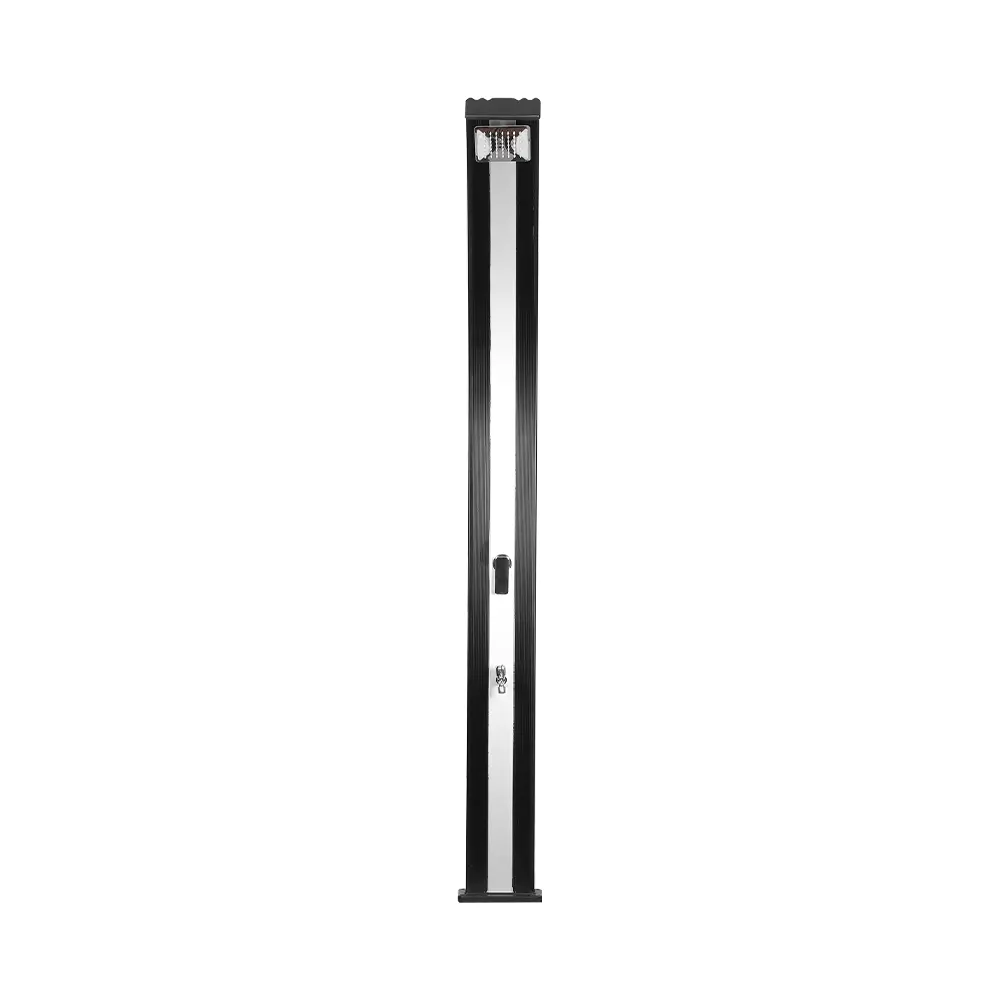
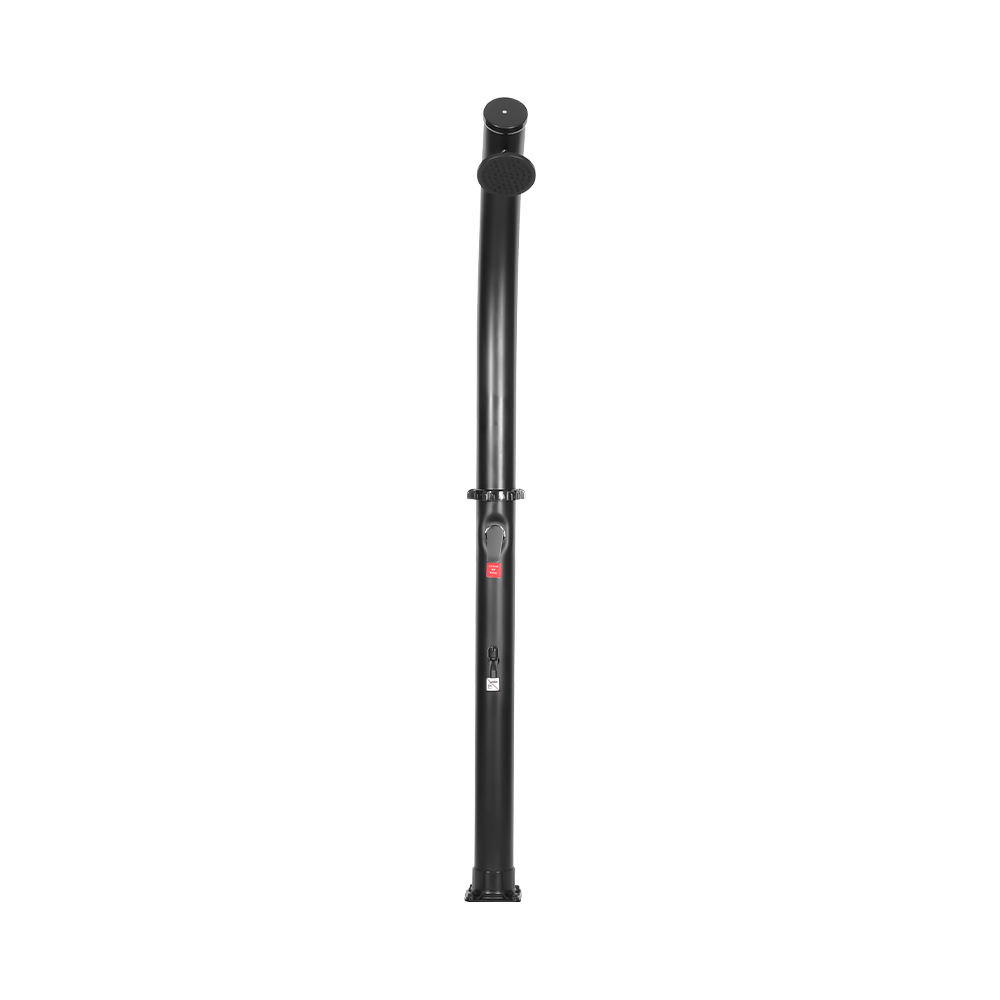
① Freestanding Solar Shower
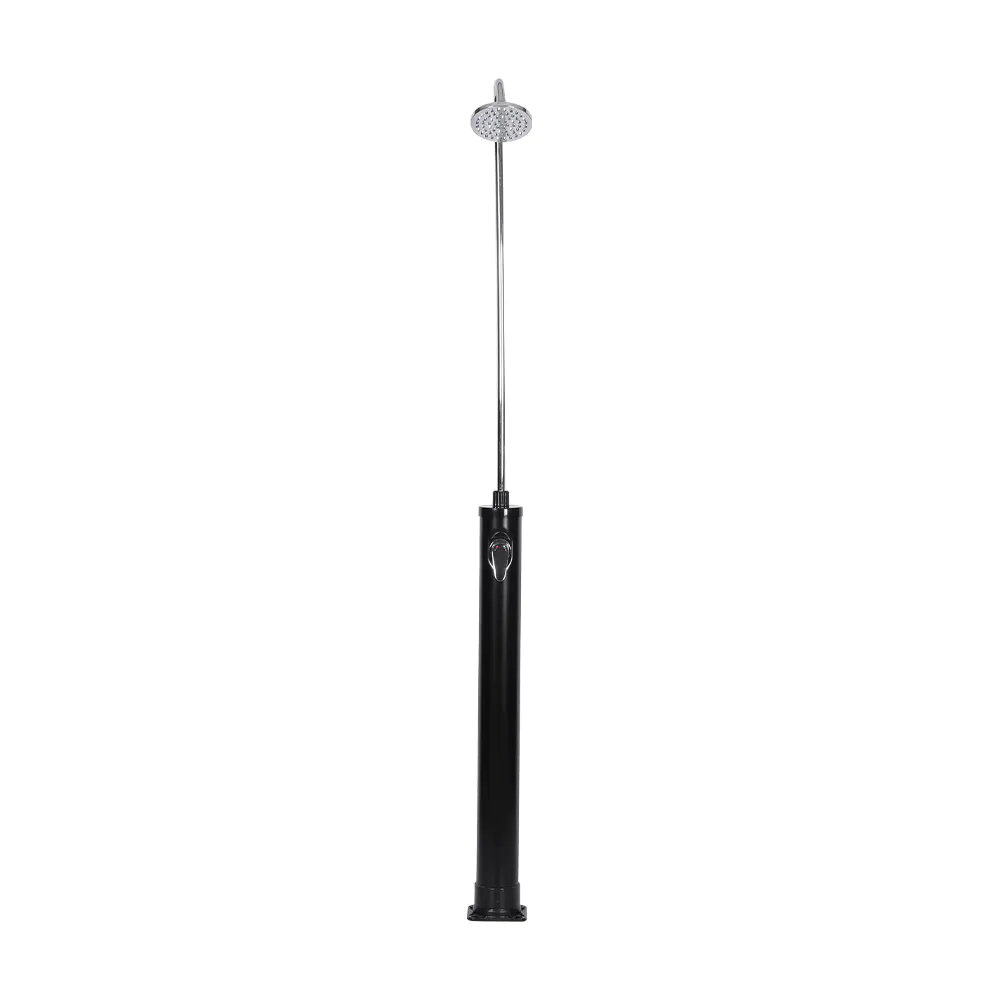
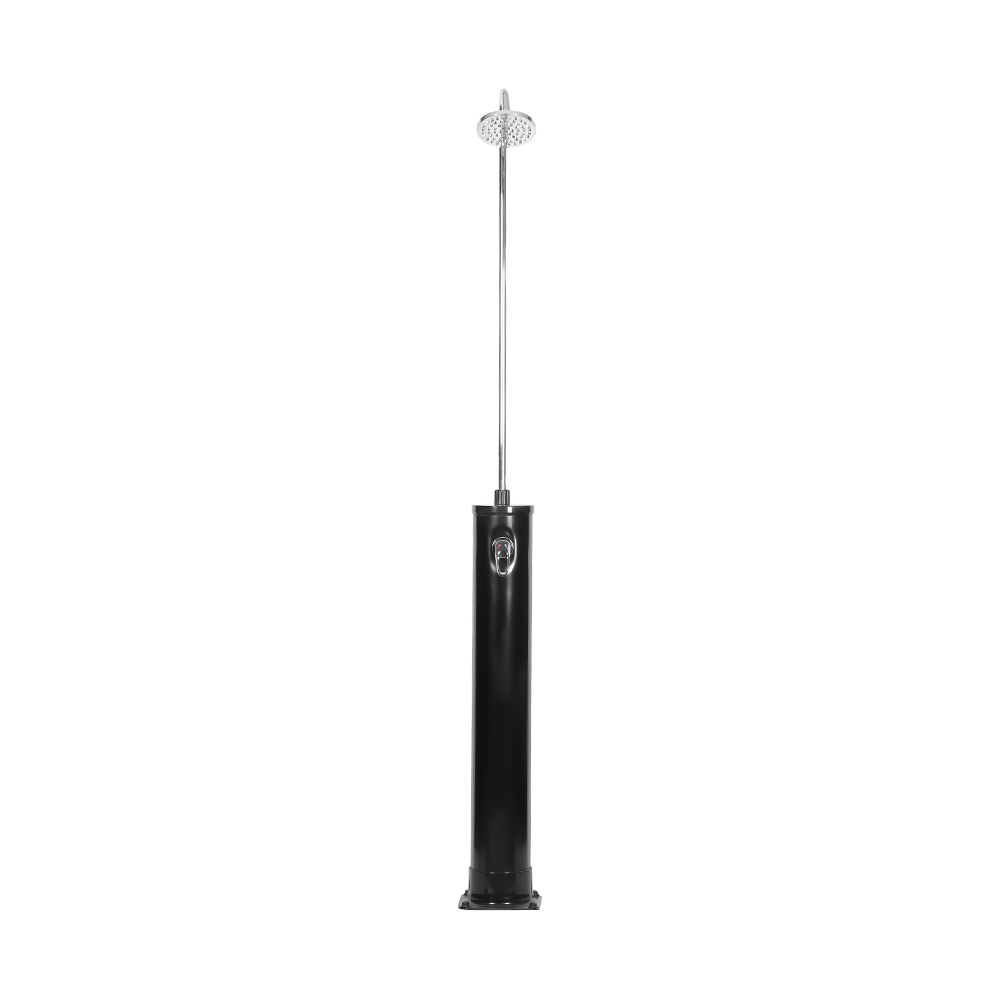
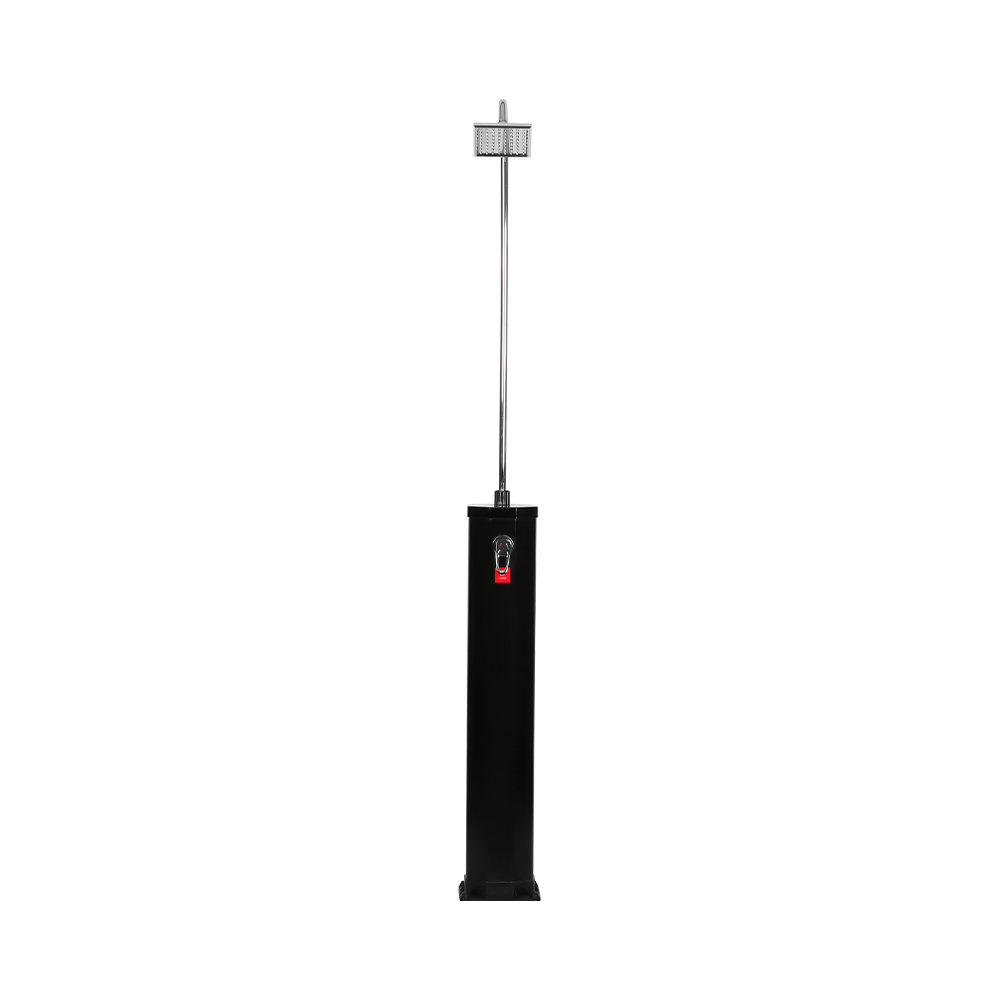
The most popular choice for private pools. It comes as a self-contained unit with its own base or ground spike, so no wall or surface mounting is needed. Easy to reposition and ideal for pools where drilling into walls isn't an option.
② Wall-Mounted Solar Shower
Fixed to a wall, fence, or post beside the pool. Takes up less floor space and tends to look cleaner and more permanent. Better suited for pools with a solid structure nearby.
③ Portable / Camping-Style Solar Shower
A lightweight bag or collapsible unit that hangs from any elevated point. More common in camping contexts but occasionally used for small pool setups or as a backup option. Tank capacity is usually much smaller.
Key Structural Components
Understanding what's inside a swimming pool solar shower helps you make a smarter buying decision:
| Component | Function |
|---|---|
| Water Tank | Stores and heats water via solar absorption |
| Outer Casing | Protects the tank; dark colors improve heat absorption |
| Shower Head | Controls spray pattern and water flow |
| On/Off Valve | Regulates water release |
| Foot Wash Tap | Low-level tap for rinsing feet before entering the pool |
| Base / Anchor | Keeps the unit stable on poolside surfaces |
| Water Inlet | Connection point for hose or manual filling |
Material Overview: What Are Solar Showers Made From?
The material of a swimming pool solar shower affects durability, heat retention, and how well it holds up over years of outdoor use. Here's a quick breakdown of the most common options:
| Material | Heat Retention | Durability | Weight | Best For |
|---|---|---|---|---|
| HDPE Plastic | Good | Very Good | Light | Residential pools, budget-friendly |
| Stainless Steel | Excellent | Excellent | Heavy | Long-term installations, coastal areas |
| ABS Plastic | Moderate | Good | Light | Portable or seasonal use |
| Copper | Excellent | Excellent | Heavy | Premium setups, fast heating |
Stainless steel and copper units tend to heat water faster and retain temperature longer, but they cost more and are heavier to install. HDPE plastic is the most common choice for home pools — it handles UV exposure well, resists corrosion, and is light enough to reposition when needed.
Why Pool Owners Are Making the Switch
The shift toward swimming pool solar showers has less to do with trends and more to do with simple practicality:
- Zero running costs — once installed, sunlight does all the work
- No electrical installation required — no licensed electrician, no wiring, no ongoing energy bills
- Environmentally low-impact — no emissions, no energy draw from the grid
- Low maintenance — far fewer moving parts than electric or gas-heated alternatives
- Doubles as a pre-swim rinse station — helps keep pool water cleaner for longer
For families with kids who are in and out of the pool all day, a poolside solar shower quickly becomes one of those things you wonder how you managed without.
2. Do Solar Showers Really Work?
Honestly, yes — but with some nuance. A swimming pool solar shower isn't going to perform like a pressure-fed indoor shower, and it's not meant to. What it does do, it does well: heat a tank of water using nothing but sunlight and deliver a comfortable, warm rinse right at the poolside. For that specific purpose, it works reliably.
The skepticism usually comes from people expecting too much, or from using a low-quality unit in the wrong conditions. Set realistic expectations and choose the right product for your climate, and a solar shower will rarely disappoint.
How Solar Energy Actually Heats the Water
The heating process isn't complicated, but it's worth understanding because it explains both the strengths and the limits of a swimming pool solar shower.
The tank is typically made from or coated in a dark material — usually matte black. Dark surfaces absorb a much higher percentage of incoming solar radiation than light-colored ones. As sunlight hits the tank throughout the day, that energy transfers into the water inside, gradually raising its temperature.
There's no pump, no thermostat, no active system involved. It's purely passive solar heating — the same principle that makes a black garden hose left in the sun scalding hot by midday.
Some higher-end units add a transparent outer cover or insulating layer around the tank to reduce heat loss, similar in concept to a greenhouse. This helps the water stay warm longer, especially in the late afternoon when solar intensity drops.
Real-World Performance: What to Expect
Under good conditions — clear sky, strong sun, tank filled in the morning — a swimming pool solar shower can heat water to anywhere between 35°C and 55°C (95°F–131°F). On peak summer days, the upper end of that range is genuinely achievable, and some units actually need to be partially vented or mixed with cold water before use.
Here's a general performance reference across different conditions:
| Condition | Expected Water Temperature | Notes |
|---|---|---|
| Full sun, summer, 6+ hours | 45°C – 55°C | May need cold water mix |
| Full sun, summer, 3–4 hours | 35°C – 45°C | Comfortable for most users |
| Partial cloud cover | 28°C – 38°C | Usable, not as warm |
| Overcast all day | 20°C – 28°C | Slightly above ambient, lukewarm |
| Winter / low sun angle | 15°C – 25°C | Marginal; depends heavily on location |
These figures are approximate and vary by tank material, tank size, wind exposure, and how well the unit is positioned. But they give a reasonable picture of what a swimming pool solar shower can deliver day to day.
Performance Across Different Climates
Geography plays a big role in how well a solar shower performs year-round.
High sun regions (Southern Europe, Australia, Southern US, Middle East)
Solar showers thrive here. Long daylight hours and high solar intensity mean tanks reach comfortable temperatures quickly — often within 2 to 3 hours. Overheating is actually a more common complaint than underheating in these climates.
Temperate regions (Northern Europe, Northern US, Canada)
Performance is strong in summer but drops considerably in spring and autumn. In winter months, a solar shower becomes impractical in most temperate zones. Seasonal use from May to September is typical.
Coastal and windy areas
Wind chill is the enemy of solar shower performance. Even on a sunny day, strong wind pulls heat away from the tank faster than the sun can replace it. In exposed coastal locations, choosing a unit with good insulation and positioning it in a wind-sheltered spot makes a meaningful difference.
Where Solar Showers Fall Short
No product is perfect for every situation. A swimming pool solar shower has some genuine limitations worth knowing about:
Dependent on sunlight
This is the obvious one. A run of cloudy days will leave you with lukewarm water at best. If you live somewhere with unpredictable weather and need guaranteed hot water every single day, a solar shower alone may not be enough.
Limited tank capacity
Most residential solar showers hold between 20 and 40 litres. That's fine for one or two rinses, but a busy family using the pool all day may run through a full tank faster than it can reheat — especially later in the afternoon when solar intensity is fading.
No temperature control
Unlike a household shower with a thermostatic mixer, a solar shower gives you whatever temperature the sun has produced. On very hot days that can mean adjusting the flow with the valve to avoid scalding. On cooler days, there's nothing you can do to boost the temperature beyond what solar input provides.
Water pressure is gravity-fed
Flow rate depends on how high the tank sits above the shower head. It's functional, but don't expect the kind of pressure you get from a mains-connected shower indoors.
So, Is It Worth It?
For poolside use specifically, a swimming pool solar shower is genuinely practical. It handles the job it's designed for — a warm rinse before or after a swim — without any running costs or installation complexity. The key is matching the product to your climate and your usage expectations.
If you're in a sun-rich region and using the pool through the warmer months, it works extremely well. If you're in a cooler climate and want hot water on demand regardless of weather, you'd either need to supplement with a backup heating option or accept that on grey days the shower will be lukewarm.
For most pool owners, those trade-offs are more than acceptable given what you get in return: free warm water, zero energy bills, and a genuinely useful poolside fixture that lasts for years with minimal upkeep.
3. How Do Solar Pool Showers Work?
The working principle behind a swimming pool solar shower is simple enough to explain in one sentence: sunlight heats the water in the tank, gravity pulls it down through the pipe, and you open the valve to release it. But there's more going on inside the unit than that one-liner suggests, and understanding the details helps explain why some solar showers perform significantly better than others.
The Core Heating Mechanism
At the heart of every solar pool shower is passive solar thermal absorption. Unlike solar panels that generate electricity, a solar shower doesn't convert sunlight into any other form of energy — it simply captures heat directly and transfers it into the water.
Here's how that process unfolds through a typical day:
Morning — Filling and Initial Exposure
The tank is filled with cold water, either manually via a hose or through a direct water line connection. As soon as sunlight hits the outer surface of the tank, absorption begins. The dark exterior (usually matte black or very dark grey) is critical here — dark surfaces can absorb upward of 90% of incoming solar radiation, compared to around 30–40% for light-colored surfaces.
Mid-Morning to Afternoon — Active Heating Phase
This is where the bulk of the heating happens. Solar intensity peaks between roughly 10am and 3pm, and during this window the water temperature inside the tank climbs steadily. In a well-designed unit, the tank material and any insulating layer work together to hold the absorbed heat rather than radiating it back out.
Late Afternoon — Heat Retention
Once solar intensity drops, the tank stops gaining heat and starts slowly losing it. How quickly it cools depends on the insulation quality, ambient air temperature, and wind exposure. A well-insulated tank might stay warm well into the evening; a basic single-wall plastic unit will cool noticeably within an hour or two of peak sun passing.
Internal Structure: What's Inside the Unit
A swimming pool solar shower looks like a simple column from the outside, but the internal layout is designed to maximise heating efficiency and water delivery.
| Component | Location | Purpose |
|---|---|---|
| Outer casing | Exterior shell | Structural protection, UV resistance |
| Dark-coated tank | Inside the casing | Absorbs solar radiation, stores heated water |
| Insulating layer | Between tank and casing | Reduces heat loss, extends warm water duration |
| Water inlet valve | Top or rear of unit | Connection point for hose or manual fill |
| Main shower head | Top of the column | Delivers water spray at head height |
| Flow control valve | Mid or lower section | Opens and closes water flow |
| Foot wash tap | Base of the unit | Low-level rinse for feet before entering pool |
| Drain plug | Base of tank | For emptying and winterising the unit |
| Stabilising base | Ground level | Weighted or ground-spike design for stability |
The vertical column design isn't just aesthetic — height matters. The taller the unit, the greater the head pressure, which translates directly into better water flow at the shower head. This is why freestanding solar showers are typically 200–250cm tall.
Water Flow: How Pressure Works in a Solar Shower
This is one of the most misunderstood aspects of swimming pool solar showers. There is no pump involved. Water flows entirely by gravity — what engineers call gravity-fed or head-pressure flow.
The pressure you feel at the shower head is determined by the vertical distance between the water surface inside the tank and the outlet. This is measured in "metres of head." As a rough guide:
| Tank Height Above Shower Head | Approximate Flow Pressure | Shower Experience |
|---|---|---|
| Less than 0.5m | Very low | Trickle, barely usable |
| 0.5m – 1.0m | Low | Gentle flow, functional |
| 1.0m – 1.5m | Moderate | Comfortable rinse |
| 1.5m – 2.0m | Good | Close to normal shower feel |
| 2.0m+ | Strong (for gravity-fed) | Best achievable without a pump |
This is why the physical height of a freestanding solar shower matters. It's not just about aesthetics or reach — taller units produce noticeably better flow. Some pool owners mount wall-fixed units at elevation specifically to gain extra head pressure.
If connected to a mains water supply rather than relying on a tank fill, the unit will deliver mains pressure regardless of its own height — though the solar heating element still works the same way.
The Role of Tank Color and Surface Coating
Not all dark tanks are equal. The specific surface treatment of the tank has a meaningful impact on how efficiently it absorbs and retains heat.
Matte black coating
The most common and effective option for solar absorption. Matte surfaces scatter incoming light rather than reflecting it, which means more energy is captured. A matte black tank will outperform a glossy black tank of the same size and material under identical conditions.
Selective coatings
Some premium units use specially engineered surface coatings that are highly absorptive across the solar spectrum but low-emissive in the infrared range — meaning they're good at taking heat in but slow to radiate it back out. This is the same technology used in professional solar thermal collectors and noticeably improves performance in less-than-ideal conditions.
Unpainted or light-colored tanks
Occasionally seen on cheaper units. These work, but significantly less efficiently. If you ever see a solar shower with a silver or light grey tank, expect substantially lower water temperatures compared to a dark-coated equivalent.
How Insulation Affects Performance
The difference between a single-wall tank and a double-wall insulated tank is more significant than most buyers realise — particularly for afternoon and evening use.
| Tank Construction | Heat-Up Speed | Heat Retention | Best For |
|---|---|---|---|
| Single-wall plastic | Fast | Poor | Morning-only use, warm climates |
| Double-wall plastic | Moderate | Good | All-day use, moderate climates |
| Insulated steel | Moderate | Very Good | Cooler climates, extended use |
| Vacuum-insulated | Slow | Excellent | Maximum retention, premium units |
A single-wall tank heats up quickly because there's nothing slowing the energy transfer — but for the same reason, it loses heat just as fast once the sun moves. A double-wall or insulated unit takes slightly longer to reach peak temperature but holds it far longer, which matters a great deal if you're using the shower in the late afternoon or on days with intermittent cloud cover.
Mains-Connected vs. Tank-Fill Solar Showers
Most swimming pool solar showers operate in one of two ways, and the distinction affects both convenience and performance:
Tank-Fill (Closed System)
Water is added manually or via a hose to a fixed-capacity tank. The solar shower heats only the water currently in the tank. Once that water is used, you need to refill and wait for reheating. Simple, self-contained, and works anywhere with sunlight.
Mains-Connected (Flow-Through System)
The unit connects directly to a water supply line. Cold water flows in continuously as you use the shower. In this configuration, the solar element pre-heats the water as it passes through — though continuous flow means the heating effect is less concentrated than in a closed tank system. Pressure is better, but peak water temperature is usually lower.
| Feature | Tank-Fill System | Mains-Connected System |
|---|---|---|
| Water pressure | Gravity-fed (low-moderate) | Mains pressure (good) |
| Peak water temperature | Higher (static heating) | Lower (flow-through) |
| Capacity limit | Fixed (20–40L typical) | Unlimited |
| Installation complexity | Minimal | Requires plumbing connection |
| Best use case | Occasional poolside rinse | High-frequency, multi-user use |
For most private pool owners, the tank-fill system is perfectly adequate and far simpler to set up. Mains-connected units make more sense for commercial pool facilities or households where the solar shower is used heavily throughout the day by multiple people.
4. Choosing the Right Swimming Pool Solar Shower
Buying a swimming pool solar shower isn't complicated, but there are enough variables involved that it's easy to end up with a unit that doesn't quite fit your situation. Tank too small for a family of four. Material that corrodes after one winter near the coast. A freestanding design when a wall-mounted one would have made far more sense for your pool layout. Getting these decisions right upfront saves a lot of frustration later.
Here's what actually matters when comparing options.
Tank Capacity: How Much Water Do You Really Need?
Capacity is usually the first spec people look at, and for good reason — it directly determines how many people can use the shower before you're waiting for a refill and reheat cycle.
| Tank Capacity | Approximate Shower Duration | Best Suited For |
|---|---|---|
| 20L | 6 – 8 minutes total | 1–2 users, occasional use |
| 25L | 8 – 10 minutes total | 1–2 users, daily use |
| 30L | 10 – 13 minutes total | Small family, 2–3 users |
| 35L | 13 – 16 minutes total | Family of 3–4 users |
| 40L | 16 – 20 minutes total | Large family or frequent use |
| 50L+ | 20+ minutes total | Commercial or multi-user settings |
These durations assume a typical gravity-fed flow rate of around 3–4 litres per minute. If your unit flows faster, those numbers come down accordingly.
For a household where two adults and two kids are in and out of the pool all day, a 20L tank will feel limiting quickly. A 35L or 40L unit gives you a much more comfortable buffer — and on a hot sunny day, the tank will likely reheat to a usable temperature between swim sessions anyway.
Material: The Decision That Affects Everything Else
Material choice touches on heat performance, longevity, maintenance, weight, and cost all at once. It's arguably the most important spec decision when choosing a swimming pool solar shower.
| Material | Heating Speed | Heat Retention | Corrosion Resistance | Lifespan | Weight | Relative Cost |
|---|---|---|---|---|---|---|
| HDPE Plastic | Good | Moderate | Excellent | 8–12 years | Light | Low–Mid |
| ABS Plastic | Moderate | Moderate | Good | 5–8 years | Light | Low |
| 304 Stainless Steel | Very Good | Good | Very Good | 15–20 years | Heavy | Mid–High |
| 316 Stainless Steel | Very Good | Good | Excellent | 20+ years | Heavy | High |
| Copper | Excellent | Excellent | Good (patinas) | 20+ years | Very Heavy | Premium |
A few things worth highlighting here:
HDPE plastic is the workhorse of the solar shower market. It handles UV exposure without degrading, doesn't rust, and is light enough to reposition without much effort. For most residential pools in non-coastal locations, it's the sensible default.
304 stainless steel is a step up in performance and durability. Heats faster, retains temperature better, and looks more premium. Suitable for most outdoor environments.
316 stainless steel is the one to specify if your pool is near the ocean. The added molybdenum content gives it significantly better resistance to salt air corrosion — 304 steel will show surface rust within a few years in a coastal environment, while 316 holds up much longer.
Copper is rare in standard solar showers but occasionally found in high-end units. It's an exceptional conductor of heat, which means faster heating and excellent retention. The trade-off is weight, cost, and the fact that copper will develop a patina over time — which some people find attractive and others don't.
Freestanding vs. Wall-Mounted: Which Configuration Fits Your Pool?
This comes down to your specific pool area layout more than personal preference.
| Feature | Freestanding | Wall-Mounted |
|---|---|---|
| Installation | Minimal — ground spike or weighted base | Requires drilling into wall or post |
| Flexibility | Can be repositioned easily | Fixed once installed |
| Footprint | Requires clear floor space | Saves floor space |
| Stability | Dependent on ground surface and anchor | Very stable once fixed |
| Aesthetics | Standalone feature, visible from all sides | Cleaner, integrated look |
| Best for | Pools without nearby solid walls | Pools with adjacent wall or fence |
If your pool area has a wall, fence, or solid post within a reasonable distance, wall-mounting usually produces a cleaner result and frees up deck space. If the pool is surrounded by open paving with no nearby structure, freestanding is the practical answer.
One thing to check with freestanding units: what the base system looks like. Some use a ground spike designed for grass or soil, which won't work on a concrete or tile pool deck without a separate weighted base. Others come with a broad platform base that sits stably on hard surfaces. Make sure the base type matches your pool surroundings.
Height: Why It Matters More Than You'd Think
Physical height affects two things simultaneously — user comfort and water pressure.
| Unit Height | Shower Head Height (Approx.) | Pressure Feel | Suitable For |
|---|---|---|---|
| 180cm | 155–165cm | Low | Children primarily |
| 200cm | 170–180cm | Moderate | Average adult height |
| 220cm | 185–195cm | Good | Taller adults |
| 240cm+ | 200cm+ | Best gravity pressure | Families, mixed heights |
For a family with adults and children using the shower regularly, a 220–240cm unit covers everyone comfortably and delivers noticeably better water pressure than a shorter model.
Features Worth Paying For
Not every feature on a solar shower spec sheet justifies the price premium, but some genuinely improve the day-to-day experience:
Foot wash tap
A low-level tap at the base of the unit for rinsing feet before entering the pool. Almost every decent solar shower includes this now, but worth confirming — it's genuinely useful and saves a lot of tracked-in debris.
Adjustable or removable shower head
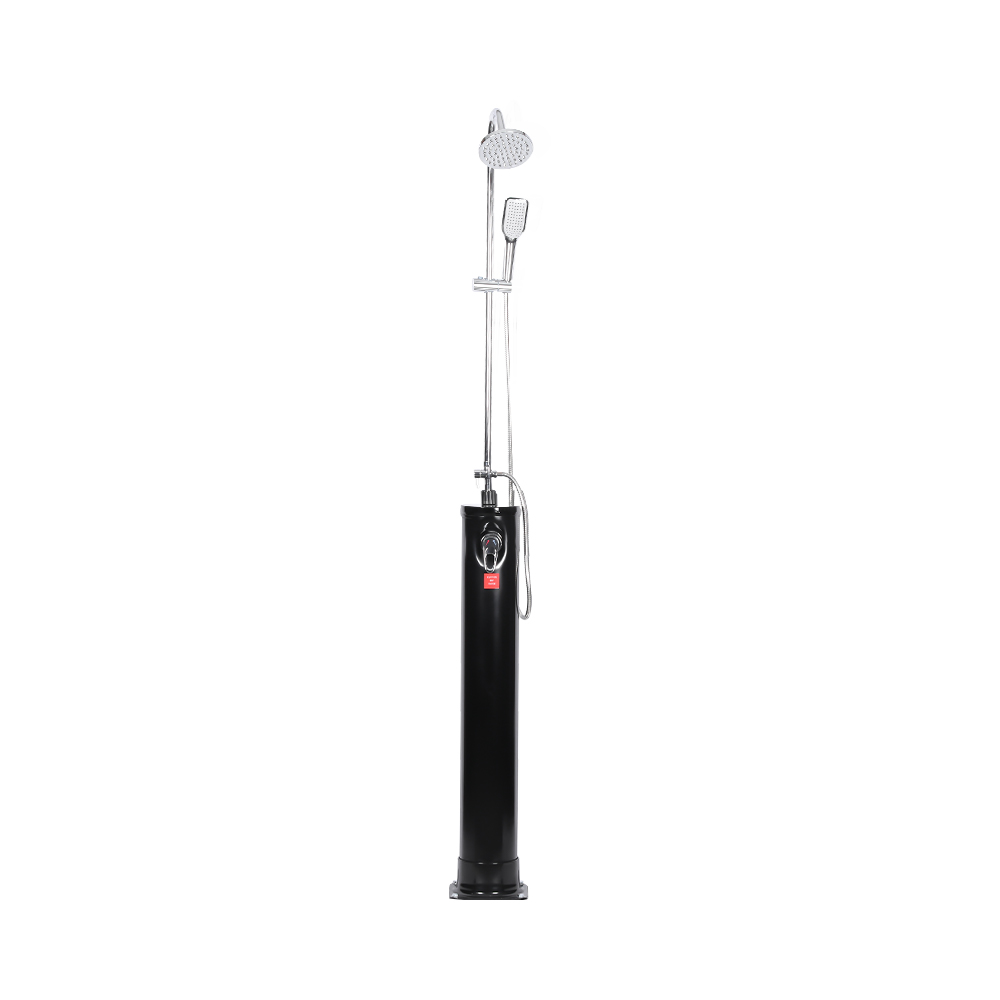
Fixed shower heads are fine, but an adjustable head that can tilt or rotate lets taller and shorter users get a comfortable spray angle. Some units include a detachable handheld head, which is particularly useful for rinsing children.
Temperature indicator
A basic thermometer strip or dial on the tank that shows approximate water temperature. Sounds minor, but on a hot day when the tank has been sitting in full sun for six hours, knowing the water is 52°C before you open the valve is useful information — especially with kids around.
Transparent outer panel or sight glass
Lets you see the water level inside the tank without opening anything. Convenient for knowing when a refill is needed.
Integrated cold water mixer
Found on mains-connected units and some higher-end freestanding models. Allows you to blend cold incoming water with the solar-heated supply to reach a comfortable temperature, similar in concept to a thermostatic shower mixer indoors.
Anti-UV coating
Relevant primarily for plastic units. A quality UV stabiliser in the material or applied as a coating prevents the outer casing from becoming brittle, fading, or cracking after years of sun exposure. Worth checking if the product specs mention UV resistance explicitly.
Weatherproofing and Long-Term Outdoor Durability
A swimming pool solar shower lives outside 365 days a year in most installations. That means rain, UV radiation, wind, potentially frost, and in coastal areas, salt-laden air. Material choice addresses most of this, but there are a few additional things to check:
- Seals and gaskets: Should be silicone or EPDM rubber rather than standard rubber, which degrades faster outdoors
- Valve quality: Brass valves outlast plastic ones significantly; worth checking what the flow control and foot tap valves are made from
- Fastener material: Screws and fittings should be stainless steel throughout — a stainless steel tank with carbon steel bolts will still rust at the fastener points
- Drain plug: Essential for winter emptying; make sure it's easy to access and operates reliably
Quick Decision Guide
If you're still unsure which direction to go, this simplified guide covers the most common situations:
| Your Situation | Recommended Choice |
|---|---|
| 1–2 users, sunny climate, tight budget | 20–25L HDPE plastic, freestanding |
| Family of 4, regular use | 35–40L stainless steel, freestanding or wall-mounted |
| Coastal location, salt air exposure | 316 stainless steel, any configuration |
| Limited pool deck space | Wall-mounted, any material |
| Commercial pool or high daily usage | 50L+ mains-connected unit |
| Mixed adult and child users | 220–240cm height, adjustable shower head |
| Cooler temperate climate | Double-wall insulated tank, dark matte coating |
No single unit is perfect for every situation, but matching these core variables — capacity, material, configuration, and height — to your actual pool setup will get you 90% of the way to the right choice before you've even looked at a specific product.
5. How Long Does a Solar Shower Take to Heat Up?
This is probably the most practical question anyone asks before buying a swimming pool solar shower. The honest answer is: typically 2 to 4 hours under good conditions. But that range covers a lot of ground, and understanding what sits behind it helps you plan usage around your actual day rather than just hoping the water is warm when you need it.
The Baseline: What "Good Conditions" Actually Means
When manufacturers quote heating times, they're usually assuming a best-case scenario — full sun, minimal wind, mid-summer solar intensity, tank filled with cold water first thing in the morning. In practice, most users are working with something slightly less than ideal on any given day.
A realistic heating timeline for a 30–35L swimming pool solar shower under typical summer conditions looks something like this:
| Time of Day | Approximate Water Temperature | Notes |
|---|---|---|
| 8:00 AM (fill) | 15°C – 20°C | Starting temperature, cold fill |
| 9:00 AM | 20°C – 26°C | Heating begins, slow initial rise |
| 10:00 AM | 26°C – 33°C | Solar intensity building |
| 11:00 AM | 33°C – 40°C | Approaching comfortable range |
| 12:00 PM | 40°C – 46°C | Fully usable, warm to hot |
| 1:00 PM – 3:00 PM | 46°C – 55°C | Peak temperature, may need mixing |
| 5:00 PM | 38°C – 48°C | Still warm, slight drop |
| 7:00 PM | 30°C – 40°C | Cooling, still usable |
| 9:00 PM | 22°C – 32°C | Noticeably cooler |
These figures assume a clear day with moderate ambient temperature around 25°C. A black matte HDPE or stainless steel tank, positioned in direct unobstructed sun with minimal wind.
Variables That Affect Heating Speed
No two installations heat at exactly the same rate. Several factors push that 2–4 hour window in either direction:
Tank Size
Larger volumes of water take longer to heat — straightforward physics. A 20L tank will reach target temperature noticeably faster than a 40L tank under identical conditions. If you want warm water available by mid-morning, a smaller tank is the faster option. If you need more capacity for a full family, accept the longer wait or fill earlier.
| Tank Size | Approx. Heat-Up Time (Full Sun) |
|---|---|
| 20L | 1.5 – 2.5 hours |
| 25L | 2 – 3 hours |
| 30L | 2.5 – 3.5 hours |
| 35L | 3 – 4 hours |
| 40L | 3.5 – 5 hours |
| 50L | 4.5 – 6 hours |
Starting Water Temperature
Filling the tank with water that's already been sitting in a warm hose or pipe gives you a head start. Conversely, cold groundwater straight from a well will take longer to reach the same end temperature. The difference between 10°C and 20°C starting water isn't trivial — it can add 30 to 60 minutes to your heat-up time.
Tank Material and Coating
As covered in the previous section, material affects both how quickly heat is absorbed and how well it's retained. A matte black stainless steel tank will outperform a lighter-coated plastic tank in heating speed under the same conditions.
| Tank Material | Relative Heat-Up Speed |
|---|---|
| Matte black HDPE | Good |
| Matte black stainless steel | Very Good |
| Copper | Excellent |
| Light-colored or glossy plastic | Below Average |
| Double-wall insulated | Slightly slower initially, better retention |
Sun Angle and Panel Orientation
A solar shower positioned where the tank face is perpendicular to incoming sunlight absorbs more energy than one sitting at an angle. In most fixed installations this isn't something you can continuously adjust, but initial placement decisions matter. South-facing in the northern hemisphere, north-facing in the southern hemisphere — oriented to catch the most direct sun through peak hours.
Ambient Temperature
Hot air temperatures slow heat loss from the tank, which indirectly speeds up the net heating effect. On a 35°C day, the tank loses heat to the surrounding air much more slowly than on a 15°C day with the same solar intensity. This is one reason solar showers perform so well on hot summer days even if cloud cover occasionally interrupts direct sun.
Wind Exposure
Wind is consistently underestimated as a factor. Convective heat loss from wind can significantly slow heating and reduce peak temperature. A solar shower sitting in an exposed position on a breezy day might reach 10–15°C lower peak temperature than the same unit sheltered behind a wall or fence. If your pool area is windy, placement in a sheltered spot pays dividends.
| Wind Condition | Estimated Impact on Peak Temperature |
|---|---|
| Calm (less than 10 km/h) | Minimal loss, near full potential |
| Light breeze (10–20 km/h) | 5°C – 8°C reduction |
| Moderate wind (20–35 km/h) | 10°C – 15°C reduction |
| Strong wind (35km/h+) | 15°C – 20°C+ reduction |
Morning vs. Afternoon Use: Timing It Right
Most pool owners use their swimming pool solar shower in the afternoon — after a swim, before heading inside. That lines up well with the heating curve: fill in the morning, peak temperature by midday to early afternoon, use through the afternoon while the tank is still warm.
Where people run into problems is when they fill the tank at noon and expect it to be ready by 2pm. Depending on tank size and conditions, that might work — but it's cutting it close. A better habit is filling first thing in the morning, even before you head out to the pool, and letting the sun do its work over 4–6 hours.
Morning use is less common but very achievable if you fill the tank the evening before. Overnight heat loss varies by material and ambient temperature, but a well-insulated unit in mild summer conditions can retain enough warmth to deliver a comfortable morning rinse without any additional solar input. In cooler climates, overnight heat loss is more significant.
Tips to Maximise Heating Efficiency
A few practical adjustments that genuinely make a difference:
Fill with warm water when possible
If your hose has been sitting in the sun, the water inside it is already warm. Running the tap for a minute to clear the cold water before filling the tank gives you a warmer starting point.
Position facing peak sun hours
The window between 10am and 2pm is when solar intensity is highest. Make sure nothing casts a shadow on the tank during these hours — a nearby tree, pergola overhang, or fence can cut heating efficiency significantly.
Use a cover or insulating jacket on the tank overnight
Some users wrap the tank in a simple insulating cover at night to reduce heat loss. This is particularly useful in shoulder seasons — spring and early autumn — when overnight temperatures drop more sharply.
Keep the tank dark and clean
Algae growth or mineral deposits on the outer surface of the tank can reduce solar absorption over time. A periodic rinse and wipe-down of the exterior keeps the surface in optimal condition.
Reduce wind exposure at the installation point
Even a simple windbreak — a nearby fence, hedge, or screen panel — can meaningfully improve both heating speed and peak temperature, particularly in exposed garden settings.
Don't overfill
A completely full tank takes longer to heat than one filled to 80% capacity. If you only need water for two or three people, filling to three-quarters gives you faster heat-up and the same usable volume for your purposes.
What About Cloudy or Cold Days?
This is where expectations need to be managed honestly. A swimming pool solar shower on a fully overcast day is not going to deliver the same experience as a clear summer afternoon. Diffuse solar radiation still penetrates cloud cover — the tank will absorb some energy — but peak temperatures will be considerably lower.
| Sky Condition | Approx. % of Clear-Sky Heating Achieved |
|---|---|
| Clear, full sun | 100% |
| Light cloud / hazy | 70% – 85% |
| Partly cloudy | 50% – 70% |
| Heavily overcast | 20% – 40% |
| Rain / full cloud cover | 10% – 20% |
On a heavily overcast day in a temperate climate, you might reach 25–30°C after a full day of exposure — cool by most standards, but still above ambient temperature. Whether that's acceptable depends entirely on personal preference and what you're using the shower for.
For pool owners in climates with genuinely unpredictable summers, having the option to top up the tank with warm water from an indoor tap on grey days is a practical workaround — not elegant, but it keeps the shower functional regardless of what the weather is doing.
6. How Long Does a 20L Solar Shower Last?
A 20L swimming pool solar shower will last somewhere between 6 and 10 minutes of continuous flow — but that single number doesn't tell the whole story. How long the water actually lasts depends on how you use it, who's using it, and what flow rate the unit delivers. Understanding these variables helps you decide whether 20L is genuinely enough for your situation or whether you'd be better served by a larger tank from the outset.
The Basic Maths: Flow Rate vs. Tank Volume
Everything comes down to flow rate. A gravity-fed swimming pool solar shower typically delivers somewhere between 2 and 5 litres per minute depending on tank height, valve opening, and water level in the tank. Note that flow rate drops gradually as the tank empties — less water above the outlet means less head pressure, which means slower flow toward the end of the tank.
| Flow Rate | 20L Duration | 30L Duration | 40L Duration |
|---|---|---|---|
| 2 L/min (low) | ~10 minutes | ~15 minutes | ~20 minutes |
| 3 L/min (moderate) | ~7 minutes | ~10 minutes | ~13 minutes |
| 4 L/min (good) | ~5 minutes | ~7.5 minutes | ~10 minutes |
| 5 L/min (high) | ~4 minutes | ~6 minutes | ~8 minutes |
Most residential solar showers operate in the 3–4 L/min range under normal conditions. That gives a 20L tank a realistic working duration of 5 to 7 minutes of continuous flow — enough for one thorough rinse, or two quick ones.
Real-World Usage: How People Actually Use a Solar Shower
Nobody stands under a solar shower for 7 straight minutes the way they might in an indoor shower. Poolside shower behaviour is different — shorter, more functional, often stop-start.
A typical poolside rinse pattern looks more like this:
Quick pre-swim rinse — 30 to 60 seconds. Wet the body down before entering the pool. Very low water consumption, maybe 1–2 litres total.
Post-swim chlorine rinse — 2 to 4 minutes. Rinse hair and body to remove chlorine and pool water. 6–12 litres depending on flow rate and thoroughness.
Full wash after swimming — 4 to 6 minutes. Hair wash, body wash, proper rinse-off. 12–20 litres, which can use most or all of a 20L tank.
Children's rinse — typically faster than adults, 1 to 2 minutes per child.
Looked at this way, a 20L tank comfortably handles two or three quick poolside rinses, or one thorough wash plus one quick rinse. For a single user or a couple using the shower casually, 20L is genuinely adequate on most days.
When 20L Starts to Feel Small
The limitations of a 20L swimming pool solar shower become apparent in a few specific situations:
Families with children
Four people rinsing off after an afternoon swim can burn through 20L faster than expected — particularly if hair washing is involved. The last person may find themselves with a trickle rather than a proper flow.
Back-to-back use throughout the day
If the pool is in heavy use from morning to evening, a single 20L fill won't last the full day. You'll need to refill and wait for the tank to reheat — which, as discussed in the previous section, takes 1.5 to 2.5 hours for a 20L tank under good sun.
Washing hair regularly
Rinsing long or thick hair thoroughly takes more water than most people account for. A hair wash alone can consume 5–8 litres, leaving little in the tank for the rest of the body.
High-pressure use
If your unit has a particularly generous flow rate — either because it's mains-connected or positioned at significant height — a 20L tank depletes faster than the duration figures above suggest.
Comparing Tank Sizes: 20L vs. 30L vs. 40L
This comparison is probably the most useful practical reference for anyone deciding between capacity options:
| Feature | 20L | 30L | 40L |
|---|---|---|---|
| Typical users per fill | 1–2 | 2–3 | 3–5 |
| Heat-up time (full sun) | 1.5–2.5 hrs | 2.5–3.5 hrs | 3.5–5 hrs |
| Continuous flow duration | 5–7 min | 8–12 min | 13–18 min |
| Weight when full | ~20 kg | ~30 kg | ~40 kg |
| Unit physical size | Compact | Mid-size | Large |
| Best for | Singles, couples | Small families | Large families |
| Refill frequency (busy day) | 2–3 times | 1–2 times | Once |
| Reheating waits per day | Frequent | Occasional | Rare |
The weight column is worth paying attention to if you're considering a freestanding unit that might need repositioning. A full 40L tank weighs 40kg — combined with the weight of the unit itself, that's not something you move casually. A 20L unit is considerably more manageable.
Stretching a 20L Tank Further
If you already have a 20L swimming pool solar shower or are set on that capacity for practical reasons, there are a few habits that make the water go further:
Turn the valve off between rinses
Sounds obvious, but leaving the shower running while soaping up or helping a child wastes several litres that could serve another person. A stop-start approach to valve use extends the tank noticeably.
Use the foot tap for feet only
The low-level foot wash tap uses the same tank water. If everyone rinses their feet before getting into the pool — which is good pool hygiene practice — that's an additional draw on the 20L supply. Being selective about when the foot tap is used versus the main shower head helps manage the overall budget.
Pre-wet with a garden hose
For a quick initial wet-down before lathering, a cold garden hose serves the purpose perfectly well and preserves the warm solar-heated water for the rinse phase where temperature actually matters.
Partial fills for partial use
If only one person needs a rinse in the afternoon, there's no need to have a fully topped-up tank. Filling to exactly the volume you need — and no more — means faster heating and the right amount of water for the occasion.
Is 20L Enough? A Straight Answer
For a single person or a couple who use the pool casually and want a quick warm rinse after swimming, 20L is perfectly adequate. It heats up faster than any other capacity, the unit is lighter and easier to handle, and under normal use it won't leave you running short mid-shower.
For a family of three or more, or anyone who uses the pool intensively throughout the day, 20L will feel limiting within the first week. The constant refilling and waiting for the tank to reheat gets old quickly. Stepping up to 30L or 35L costs relatively little more and makes the day-to-day experience significantly smoother.
The honest advice: if you're on the fence between 20L and 30L, go with 30L. The extra capacity costs marginally more, adds maybe an hour to the heat-up time, and removes the frustration of running dry at an inconvenient moment. The 20L option makes most sense when space, weight, or budget are genuine constraints — not just because it's the smallest available.
7. Installation & Placement Tips for Pool Solar Showers
Getting the installation right matters more than most people expect. A swimming pool solar shower that's poorly positioned — too much shade, wrong surface, exposed to prevailing wind — will underperform consistently regardless of how good the unit itself is. Spend a bit of time on placement decisions before committing to a fixed installation, and the shower will reward you with better temperatures and a longer service life.
Start With Sun Mapping Your Pool Area
Before deciding exactly where the unit goes, spend a day observing how sunlight moves across your pool area. What looks like a sun-drenched spot at 9am might be in partial shade by 2pm due to a neighbouring fence, pergola, or tree. Since peak solar heating happens between 10am and 3pm, the unit needs to be in direct unobstructed sun during those hours specifically — not just at some point during the day.
A few things to check during your sun mapping:
- Which direction does the pool area face? South-facing aspects in the northern hemisphere receive the most direct sun; north-facing in the southern hemisphere.
- Are there any structures — walls, pergolas, umbrellas, shade sails — that cast moving shadows through the day?
- Does a neighbouring building or tree shade any part of the area in late morning or early afternoon?
- Is there a naturally sheltered spot that gets full sun but is protected from the prevailing wind direction?
That last point — finding a spot that combines full sun exposure with wind shelter — is the ideal placement scenario for a swimming pool solar shower. It maximises heat gain while minimising convective loss.
Freestanding Installation: Ground Surface Matters
Freestanding solar showers come with one of two base systems, and the right choice depends entirely on what surface surrounds your pool.
| Base Type | Suitable Surface | Notes |
|---|---|---|
| Ground spike | Grass, soil, gravel | Firm and stable; not suitable for hard surfaces |
| Weighted platform base | Concrete, tile, paving, decking | Broad footprint for stability on flat surfaces |
| Bolt-down base plate | Concrete, tile | Most secure option; requires drilling |
| Adjustable levelling feet | Any firm flat surface | Useful for slightly uneven decking or paving |
If your pool is surrounded by concrete or tile — which is most common — make sure the unit you choose comes with a platform base or bolt-down option rather than a ground spike. A spike going nowhere on a concrete deck is a stability problem waiting to happen, particularly in wind.
For grass or soil surrounds, a ground spike is simple and effective. Push it in to the recommended depth, check the unit is vertical, and you're done. The main thing to confirm is that the spike length is adequate for your soil type — a shorter spike in loose or sandy soil may not hold the unit stable enough in a strong gust.
Stability check before finalising placement:
Once the unit is in position, give it a firm push from different directions to test stability before filling the tank. A full 30–40L tank adds significant weight at the top of the column, which shifts the centre of gravity upward. What feels stable when empty may wobble with a full tank and a gust of wind behind it.
Wall-Mounted Installation: Getting It Right First Time
Wall-mounted swimming pool solar showers are more permanent by nature, so it's worth taking extra care with positioning before drilling anything.
Step 1: Confirm the wall or structure can take the load
A full solar shower unit — tank, water, and fittings — can weigh 35–60kg depending on capacity and material. The mounting surface needs to be solid masonry, brick, concrete block, or a substantial timber post. Rendered surfaces over lightweight block, thin fence panels, or hollow walls are not suitable without additional structural consideration.
Step 2: Mark the bracket positions carefully
Most wall-mounted units use two or three bracket points along the column height. Use a spirit level to confirm the column will sit perfectly vertical — a slight lean looks obvious once the unit is up and is annoying to correct after the fact.
Step 3: Use the right fixings for the surface
| Wall Type | Recommended Fixing |
|---|---|
| Solid brick or masonry | Masonry anchor bolts, minimum M8 |
| Concrete block | Chemical anchor or frame fixings |
| Timber post | Stainless steel coach screws, minimum 10mm |
| Rendered wall (solid behind) | Masonry anchors through render into substrate |
| Hollow wall or thin panel | Not recommended without structural backing |
All fixings exposed to outdoor conditions should be stainless steel. Galvanised fixings will rust within a few years in an outdoor pool environment, particularly near the coast.
Step 4: Consider future access
Make sure the mounted position allows easy access to the water inlet for refilling, the drain plug at the base for winterising, and the valve controls during use. A unit mounted too high or too close to a corner can make these routine tasks awkward.
Water Supply: Hose Connection vs. Manual Fill vs. Plumbed-In
How you get water into the tank is a practical decision that affects convenience more than performance.
| Supply Method | Convenience | Installation Complexity | Notes |
|---|---|---|---|
| Manual fill (bucket or watering can) | Low | None | Viable for small tanks only |
| Garden hose connection | Good | Minimal — standard hose thread | Most common for residential use |
| Direct plumbing (fixed pipe) | Excellent | Requires plumber | Best for permanent installations |
| Rainwater tank connection | Good | Moderate | Sustainable option where rainfall is adequate |
For most home pool installations, a standard garden hose connection is the right answer. It's quick, flexible, and requires no additional plumbing work. The inlet on most solar showers accepts a standard hose fitting — just confirm thread compatibility before purchase if you're in a country where hose fittings vary.
If the shower is positioned some distance from the nearest outdoor tap, consider whether a permanent hose run to the unit makes sense. Leaving a hose permanently connected and coiled at the base of the unit is a tidy solution that avoids dragging a hose across the pool area every time you need a refill.
Drainage: Where Does the Used Water Go?
This is something many buyers don't think about until after installation. The water coming out of a swimming pool solar shower has to go somewhere, and on a tiled or concrete pool deck with no obvious drainage, that somewhere can become a puddle problem.
Options for managing drainage:
Existing pool deck drain
If your pool area already has a floor drain or channel drain, position the solar shower close enough that water flows naturally toward it. This is the cleanest solution.
Gravel or permeable surface beneath the unit
Placing the shower over a small gravel bed or permeable paving allows water to drain directly into the ground. Works well for freestanding units and avoids any standing water.
Connecting outlet to a drain pipe
Some units allow a simple drain hose to be attached to the shower base outlet, directing water to a nearby drain or garden bed. Soap and sunscreen residue means it's not ideal for vegetable gardens, but ornamental plants generally handle it without issue.
Sloped deck design
If the pool deck has a slight fall toward the pool or a perimeter drain, no additional drainage management is needed — water naturally flows where the slope takes it.
Avoid situations where shower water pools around the base of a freestanding unit on a flat surface. Standing water accelerates corrosion of the base fittings and creates a slip hazard around the pool.
Optimal Placement: A Practical Checklist
Before finalising your installation position, run through these points:
| Consideration | What to Check |
|---|---|
| Sun exposure | Direct sun from 10am to 3pm with no shadow interruption |
| Wind shelter | Protected from prevailing wind direction |
| Distance from pool | Close enough for convenience, far enough to avoid splash-in contamination |
| Surface suitability | Matches the base type of the chosen unit |
| Drainage | Clear path for used water away from the unit base |
| Water supply access | Garden hose or plumbed supply within practical reach |
| User access | Enough clear space around the unit for comfortable use |
| Structural support | Wall or post capable of carrying full load (wall-mounted) |
| Visibility and aesthetics | Positioned to complement rather than dominate the pool area |
| Winter access | Drain plug reachable for off-season emptying |
Distance From the Pool: How Close Is Too Close?
There's no universal rule, but a sensible guideline is to position the swimming pool solar shower at least 1 to 1.5 metres from the pool edge. Close enough to be immediately accessible after climbing out, but far enough that:
- Water splashing from the shower doesn't fall directly into the pool, carrying soap and sunscreen with it
- The unit itself isn't in the splash zone from people entering the pool
- There's safe clearance around a slippery wet area adjacent to the water
In practice, most pool areas naturally dictate where the shower goes based on available space and sun exposure. But if you have flexibility in placement, the 1–1.5m buffer from the pool edge is a good starting point.
8. Maintenance & Care for Long-Term Performance
A swimming pool solar shower is about as low-maintenance as outdoor fixtures get — but low-maintenance doesn't mean no maintenance. A unit that gets a bit of regular attention will outperform and outlast one that's ignored by a significant margin. Most of what's involved takes less than 30 minutes a year. The things that go wrong with neglected solar showers are almost always preventable.
Daily and Weekly Habits That Make a Difference
None of these take meaningful time, but done consistently they prevent the slow degradation that shortens a unit's service life.
Don't leave stagnant water in the tank for extended periods
If the pool isn't being used for a week or more — a holiday, a run of bad weather — drain the tank rather than leaving water sitting in it. Stagnant warm water is an ideal environment for bacterial growth and algae. In a dark tank that reaches 40–50°C regularly, this process accelerates faster than you'd expect.
Rinse the shower head after use
Calcium and mineral deposits build up gradually on shower head outlets, particularly in hard water areas. A quick rinse and wipe after each use slows this considerably. Left unaddressed, mineral scale eventually blocks individual nozzles and reduces flow to an uneven trickle.
Keep the exterior surface clean
The dark outer surface of the tank does its job best when it's clean. Dust, bird droppings, pollen, and general outdoor grime all reduce solar absorption to some degree. A wipe-down with a damp cloth every week or two during the swimming season keeps absorption efficiency close to optimal.
Check valve operation periodically
The main flow valve and foot tap valve should open and close smoothly. If either starts to feel stiff or develops a drip when closed, address it early. A small drip left unattended becomes a larger one, and a seized valve is more difficult and expensive to fix than one that's caught early and lubricated or repacked.
Descaling: Dealing With Mineral Buildup
Hard water is the most common maintenance challenge for swimming pool solar showers in many regions. As water heats and evaporates inside the tank, dissolved minerals — primarily calcium carbonate — precipitate out and form scale deposits on internal surfaces, pipes, and the shower head.
Scale buildup affects performance in two ways: it insulates the inner tank surface slightly, reducing heating efficiency, and it gradually restricts water flow through pipes and outlets.
How to descale the tank:
The simplest approach uses white vinegar — cheap, effective, and safe for all tank materials.
| Step | Action | Duration |
|---|---|---|
| 1 | Drain the tank completely | — |
| 2 | Fill to 25% capacity with undiluted white vinegar | — |
| 3 | Leave to soak | 2–4 hours |
| 4 | Open valve briefly to flush vinegar through pipes and head | 30 seconds |
| 5 | Close valve, leave remaining vinegar in tank | Additional 1–2 hours |
| 6 | Drain fully and rinse with clean water twice | — |
| 7 | Fill, run through shower head, drain once more | — |
For heavy scale buildup that doesn't respond to vinegar alone, a diluted citric acid solution (1–2 tablespoons per litre of water) is more aggressive and still safe for stainless steel and plastic tanks. Avoid commercial descalers designed for indoor plumbing — many contain chemicals that degrade rubber seals and gaskets.
Descaling frequency by water hardness:
| Water Hardness | Descaling Frequency |
|---|---|
| Soft (below 100 mg/L) | Every 2–3 seasons |
| Moderately hard (100–200 mg/L) | Once per season |
| Hard (200–300 mg/L) | Twice per season |
| Very hard (300mg/L+) | Every 6–8 weeks during peak use |
If you're unsure about your local water hardness, most municipal water suppliers publish this data, or a simple test kit from a hardware store will give you a reading within minutes.
Shower Head Maintenance
The shower head takes more wear than any other component — constant wetting and drying cycles, mineral deposition, UV exposure to any plastic parts, and physical handling when adjusting spray angle.
Clearing blocked nozzles:
Individual nozzle outlets clog before the overall flow noticeably drops. If you notice an uneven spray pattern with some jets weaker than others, blocked nozzles are the likely cause.
Remove the shower head if it's detachable and soak it in white vinegar for 1–2 hours. For fixed heads, fill a small zip-lock bag with vinegar and secure it around the head with a rubber band, leaving it submerged for the same duration. A toothpick or thin needle can clear individual nozzle holes after soaking.
Replacing the shower head:
Most solar shower heads use standard thread sizes and can be replaced independently of the rest of the unit if they become too scaled or damaged to clean effectively. Confirm the thread size before ordering a replacement — common sizes are 1/2 inch BSP and 3/4 inch BSP, though this varies by manufacturer and country of origin.
Valve and Seal Maintenance
Valves are the moving parts most likely to give trouble over time. The two most common issues are slow drips when the valve is closed and stiffness when operating the handle.
For stiff valves:
A small amount of silicone grease applied to the valve stem — not petroleum-based grease, which degrades rubber seals — typically restores smooth operation. This is a two-minute job that extends valve life significantly.
For dripping valves when closed:
Usually indicates a worn or compressed internal washer or O-ring. Most ball valves and gate valves used in solar showers use standard-sized O-rings and washers available from any plumbing supplier. Replacing them is straightforward:
| Step | Action |
|---|---|
| 1 | Close the water supply or drain the tank |
| 2 | Unscrew the valve handle and packing nut |
| 3 | Remove the old washer or O-ring |
| 4 | Take the old part to a plumbing supplier to match the size |
| 5 | Install new washer or O-ring |
| 6 | Reassemble and test |
Carry a spare O-ring kit for your unit's valve sizes — they cost almost nothing and save a frustrating wait if a seal fails mid-season.
Preventing Algae Growth
Algae growth inside the tank is more common than many owners realise, particularly in units that sit partially filled in warm weather between uses. A green tint to the water or a slippery coating on internal surfaces are the telltale signs.
Prevention is straightforward:
- Don't leave the tank partially filled for more than 2–3 days without use, especially in warm weather
- Drain and dry the tank between swimming seasons rather than leaving water in it over winter or extended breaks
- Occasional chlorine rinse: filling the tank with a dilute chlorine solution (1–2ml of standard pool chlorine per litre of water), leaving for an hour, then draining and rinsing thoroughly, will eliminate algae and prevent regrowth for several weeks
If algae has already established inside the tank, a stronger chlorine treatment followed by thorough rinsing usually clears it. Persistent growth on accessible internal surfaces can be scrubbed with a bottle brush before the chemical treatment.
Seasonal Maintenance: Opening and Closing the Shower
For pool owners in climates where the swimming season has a clear start and end, a simple seasonal routine protects the unit through the off-season and ensures it's ready to perform from day one of the following year.
Start of season (spring):
| Task | Purpose |
|---|---|
| Inspect all external surfaces for damage or corrosion | Catch any deterioration over winter |
| Check and tighten all external fixings and brackets | Frost cycles can loosen fixings |
| Inspect seals and O-rings on all valves | Replace any that appear compressed or cracked |
| Run a descaling treatment before first use | Clear any mineral deposits from off-season |
| Check shower head for blockages | Clear nozzles if needed |
| Wipe down exterior surface | Restore absorption efficiency |
| Test all valve operation before filling | Confirm smooth operation before water goes in |
End of season (autumn):
| Task | Purpose |
|---|---|
| Drain the tank completely | Prevent freezing damage in cold climates |
| Open all valves to drain residual water from pipes | Water left in pipes can freeze and crack them |
| Remove and store detachable components indoors | Shower heads, hose fittings, any plastic accessories |
| Apply silicone grease to valve stems | Prevents seizing over winter |
| Cover or wrap the unit if leaving outdoors | Reduces UV degradation and weathering |
| Store freestanding units horizontally if possible | Reduces wind load and tipping risk over winter |
Winter Storage: Leave It Out or Bring It In?
This depends on the unit material and your local winter conditions.
| Climate / Material | Recommended Approach |
|---|---|
| Mild winter, stainless steel unit | Leave outdoors, drain fully, cover the head |
| Mild winter, HDPE plastic unit | Leave outdoors, drain fully |
| Cold winter with frost, any material | Drain fully, cover or store indoors if possible |
| Hard freeze climate, plastic unit | Store indoors — plastic can crack in hard frost |
| Hard freeze climate, stainless steel | Drain fully and cover; outdoor storage acceptable |
| Coastal location, any climate | Cover during off-season to reduce salt air exposure |
The single most important winter step regardless of climate or material is complete drainage. Water expands when it freezes. Any water left in the tank, pipes, or valve bodies can crack components that would otherwise last decades. It takes five minutes to drain a solar shower properly — open every valve, remove the drain plug, and leave it all open until water stops dripping.
Replacing Parts: What Wears Out and When
A quality swimming pool solar shower should last 10–20 years depending on material. The unit itself rarely fails — it's the smaller components that need periodic replacement.
| Component | Typical Lifespan | Signs of Wear |
|---|---|---|
| Valve washers / O-rings | 3–5 years | Dripping when closed |
| Shower head | 5–8 years | Blocked nozzles, cracked body |
| Hose fittings | 4–6 years | Weeping joints, cracked collars |
| Drain plug washer | 3–5 years | Slow drip from base |
| External seals | 4–7 years | Visible cracking or compression |
| Surface coating (plastic) | 8–12 years | Fading, chalking, surface crazing |
| Tank (stainless steel) | 15–25 years | Pitting, perforation (rare) |
| Tank (HDPE plastic) | 8–15 years | UV degradation, brittleness |
Keeping a small stock of the right O-ring and washer sizes for your unit means most minor repairs are a ten-minute job rather than a service call. Most manufacturers supply spare parts kits, and generic plumbing O-rings cover the majority of solar shower valve sizes in any case.
The overall picture is reassuring: a swimming pool solar shower that gets basic seasonal attention and prompt minor repairs will reliably outlast most other poolside equipment. The technology is simple, the failure modes are predictable, and almost everything that goes wrong is fixable without specialist knowledge or tools.
FAQ: Everything Pool Users Want to Know
Q1: Can a swimming pool solar shower work on cloudy days?
Yes, but with reduced performance. Diffuse sunlight still penetrates cloud cover and heats the tank, though temperatures will be noticeably lower than on a clear day. Light cloud typically delivers 70–85% of clear-sky heating, while heavy overcast drops to 20–40%. On grey days, the water will usually be above ambient temperature but may feel lukewarm rather than warm. Topping up with hot water from an indoor tap is a practical workaround on persistently overcast days.
Q2: Is the water from a solar shower safe for children's skin?
Yes. Solar-heated water is no different from any other warm water — there are no chemical additives or treatment processes involved. The main safety consideration with children is temperature: on a hot summer day, tank water can reach 50°C or above, which is uncomfortably hot. Run the shower for a few seconds before letting children use it, or check the temperature indicator if the unit has one. Many parents also open the valve slightly to mix in cooler residual water before use.
Q3: How hot does a solar shower water actually get?
Under full summer sun with 4–6 hours of exposure, water in a well-designed unit typically reaches 40–55°C. In very hot climates with prolonged sun exposure, temperatures above 55°C are possible. This is hotter than most people want for a shower — a comfortable rinse temperature is generally 35–42°C — so on peak days you may need to run the valve partially or mix in cold water to bring the temperature down to a comfortable level.
Q4: Can I install a solar pool shower myself without a plumber?
In most cases, yes. Freestanding units require no plumbing knowledge at all — set up the base, connect a garden hose to the inlet, and you're done. Wall-mounted units involve drilling and anchoring, which is within the scope of a confident DIYer with the right tools. The only scenario that typically requires a licensed plumber is connecting the unit directly to a mains supply pipe through a fixed wall penetration, which may also be subject to local building regulations depending on your location.
Q5: How do I prevent my solar shower from overheating in summer?
A few practical options: fill the tank later in the morning rather than at first light, so it has less total heating time before peak use; use a light-coloured cover over the tank during the hottest part of the day if you won't be using it until afternoon; or install a simple mixing valve that allows cold mains water to blend with the hot tank water at the outlet. Most users simply learn to run the shower briefly before stepping in, or open the valve only partially to slow the flow and cool it slightly.
Q6: What is the lifespan of a typical swimming pool solar shower?
A quality unit with proper seasonal maintenance should last 10–20 years. Stainless steel and copper units at the higher end of that range or beyond; HDPE plastic units typically 8–15 years before UV degradation becomes noticeable. Small components — valves, seals, shower heads — will need replacement every few years, but the core unit itself is durable. The biggest factors affecting lifespan are material quality, climate, and whether the unit is properly drained and stored during winter.
Q7: Are solar pool showers eco-friendly compared to electric pool showers?
Significantly so. A solar shower uses no electricity, produces no emissions during operation, and has a very low manufacturing footprint relative to its lifespan. An electric poolside shower requires wiring, ongoing energy consumption, and generates emissions depending on the local electricity grid. The environmental trade-off is that a solar shower is weather-dependent and may occasionally need supplemental hot water — but for the majority of use days in a typical pool season, solar heating covers the need entirely without any grid energy draw.
Q8: Can I use a solar shower year-round in cooler climates?
Practically speaking, no — not as a standalone solution. In temperate climates, solar showers perform well from late spring through early autumn. Outside this window, solar intensity is insufficient to heat the water to a comfortable temperature in most northern European or northern North American locations. Year-round use is feasible in Mediterranean climates, Australia, Southern US, and similar regions where winter sun is still relatively strong. In cooler climates, the unit should be drained and stored or covered for the off-season to prevent frost damage.
-
How Do You Maintain and Clean Your Solar Shower for Long-Term Use
Empty the Tank After Each Use Maintaining the cleanliness and functionality of your solar shower is ...
-
Comprehensive Guide to Solar Showers: From Portable Bags to Luxury Poolside Units
Introduction to Solar Showers What is a Solar Shower? A solar shower is an innovative and environmen...
-
How to Choose the Perfect 8L Solar Shower for Beach, Pool & Garden Use
Benefits of Using an 8L Solar Shower at the Beach 1. Convenience and Portability for Beachgoers An 8...
-
The Ultimate Guide to 18L Solar Showers: Reviews, Tips, and How-To
Introduction to 18L Solar Showers In recent years, 18L solar showers have become a must-have item fo...
No.27, Fengshan Road, Hangfu Town, Kecheng District, Quzhou City, Zhejiang Province, China
(+86)-17888203192
 Wholesale Outdoor Solar Shower Factory